


Notre Dame faced a challenge similar to that of many other facilities around the world: roof systems that could not deliver reliable performance beyond 20 years. | Photo Credit (all): FiberTite
By Ray Makiejus
The stakes of roof failure are high for any building. This is especially true of educational buildings, where the price of failure can result in significant disruption to students’ education.
For the University of Notre Dame—one of the nation’s most respected campuses and home to more than 4 million square feet of low-slope roofing across its many facilities—failure is simply not an option. It’s why the school’s facility management team made a critical decision regarding roofing standards across the entire campus. That decision is paying dividends today, helping ensure greater roof longevity and reliability.
“We couldn’t afford to replace roofs every 20 years or so,” said Tony Polotto, Senior Director of Construction and Quality Assurance. “We needed a solution that could go the distance.”
Indeed, several years ago, Notre Dame faced a challenge similar to that of many other facilities around the world: roof systems that could not deliver reliable performance beyond 20 years. As cracks, leaks, and premature failures drove up costs and disrupted campus operations, Polotto was tasked with vetting higher-performing systems that could eliminate these problems.
“My boss basically said, ‘Go find me a roof that’s been on a building for more than 20 years and is still performing,’” Polotto said. “That was the mandate.”
To meet the requirements, Polotto and his team identified ketone ethylene ester (KEE)-based roof systems as a potential solution. In practice, this type of roof material has delivered returns for the organization years later.
Evaluating Common Material Performance
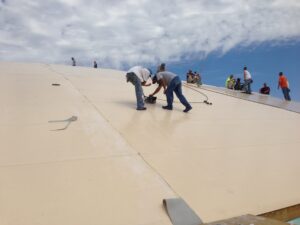
Low-slope commercial roofs—whether on an educational facility, industrial plant, hospital, or any other type of structure—typically use one of four types of single-ply membranes:
- Thermoplastic polyolefin (TPO)
- Polyvinyl chloride (PVC)
- Ethylene propylene diene monomer (EPDM)
- Ketone ethylene ester (KEE)
TPO has become the most widely installed membrane in the United States due to its low purchase cost, common installation practices and broad familiarity among commercial roofing contractors. Both TPO and EPDM offer similar upfront cost advantages compared to PVC and KEE roofs. However, initial savings do not necessarily equal long-term value or protection.
For example, KEE-based membranes—specifically those meeting American Society for Testing and Materials (ASTM) standards—are recognized for providing exceptional puncture and weathering compared to TPO or EPDM. This is because ASTM-compliant KEE membranes contain a dense fiber reinforcement layer as part of their construction, where other common membranes do not. Such construction advantages enable KEE membranes to deliver performance benefits while consuming fewer raw materials (one 36-mil membrane is recognized as an alternative to most 60-mil membranes).
These attributes can make a significant difference over the course of a roof system’s anticipated service life, resulting in greater resistance to common modes of failure. In the case of a severe storm, for example, a KEE membrane could be more likely to resist puncture and impact from flying debris or foreign objects that may impact the roof.
Notre Dame Discovers the KEE Difference
Polotto’s team started with research, first to identify potential solutions and then to learn how they were produced and how they performed in the field. The team obtained samples and consulted with multiple manufacturers, including one that produces a KEE-based membrane.
“We saw how it was built, and the difference in the scrim and material was obvious,” Polotto said, noting the variances between KEE and other common materials. “You can see and feel the contrast in the fabric. It’s clear that it’s built to withstand the stresses of foot traffic, weathering and puncture.”
Furthermore, KEE has also established itself within the industry as a high-performance option proven to deliver excellent longevity and service life. Some KEE roof systems have performed for more than 40 years, and it was this kind of demonstrated track record that Notre Dame needed to move forward.
Creating a New Standard for Performance
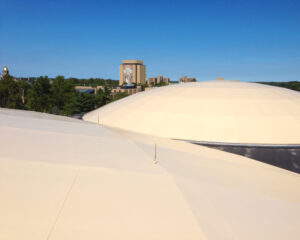
The first KEE installation on the Notre Dame campus was in 2005, and the difference became clear quickly. The KEE system included a FiberTite® membrane from Seaman Corporation, which has demonstrated consistent performance since that time, and was adopted as the campus standard for low-slope roofing.
Twenty years later, the university has installed approximately 2 million square feet of KEE membrane and has not experienced any system failure. Maintenance has been minimal, limited to routine activities.
“Our roof systems are no longer a worry,” Polotto said. “We’ve seen the proof for ourselves, and there’s no looking back. It’s no surprise that Notre Dame is a big fan.”
For Notre Dame, KEE membranes represented a small increase in upfront investment compared to common alternatives. However, that investment paid off—the university has saved millions by avoiding 20-year replacement cycles. By investing in proven performance, the university has avoided disruptive replacements, doubled the service life of its roofs, and gained greater control over budgets.
“For us, the numbers tell the story,” Polotto said. “No failures in 20 years, and a system capable of lasting twice as long as the alternatives. The life cycle savings are clear.”
For educational facility managers everywhere, an investigation into higher-performance roof systems can make a real difference. From smaller local school districts to major campuses like Notre Dame, proven longevity, minimized repair and replacement costs, and reliable operation can lead to significant operational benefits.
Ray Makiejus is the FiberTite® Roof Systems Midwest Regional Manager with Seaman Corporation. He has more than 20 years of experience in building envelope consulting to support architects, consultants and owners.