

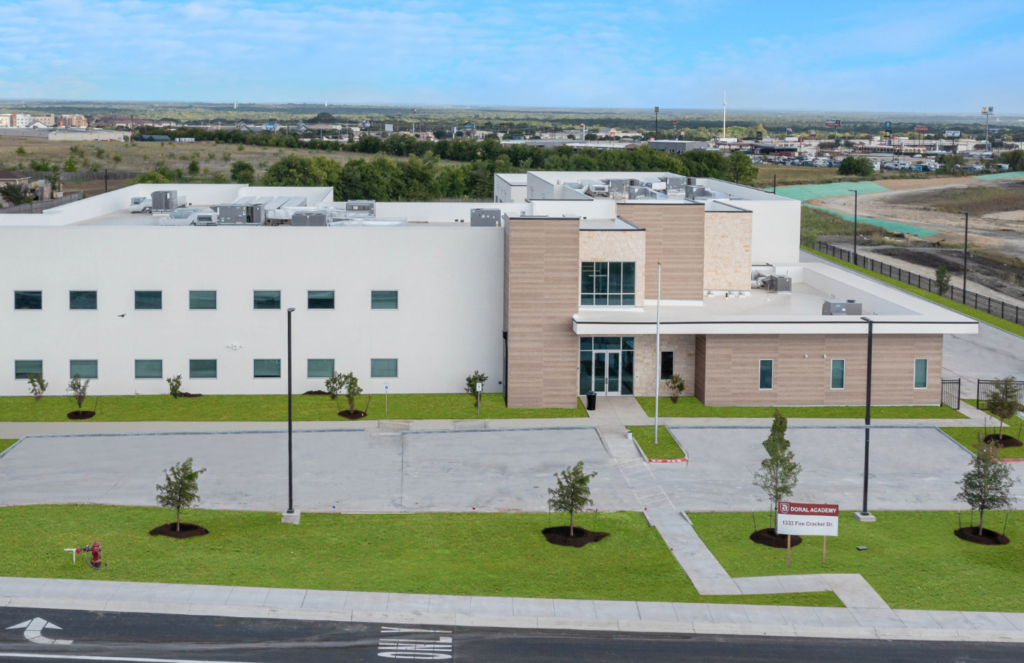
Butler Cohen served as Construction Manager at-Risk to construct a new ground-up K-8 campus for charter school operator Academica in Austin, Texas. | Photo Credit (all): Courtesy of Butler Cohen
By Jason Permenter
Design-Bid-Build, commonly referred to in the construction industry as a “hard bid” project, refers to the construction delivery method commonly utilized by school districts and other education providers, in which the design team is hired directly the owner.
The common perception is that once this delivery method is chosen, that’s it. The project’s fate is sealed, and once design and bidding are complete, the owner is stuck with the bids they receive, irrespective of their project budget, and with a limited ability at that point to cut cost overruns or meet aggressive schedule expectations. However, for owners that have already chosen this delivery method for a project, all is not lost. The careful selection of a general contractor that will work collaboratively with the owner and design team can help rescue the project, delivering effective solutions to improve budget and schedule outcomes.
Understanding the Design-Bid-Bid Process
Owners commonly choose the Design-Bid-Build process for a number of reasons. The attractiveness of competitive pricing is perhaps the biggest driver, along with a perception of budget certainty; or, maybe that is simply how a school district or education provider has always done things.
In the Design-Bid-Build process, the design team, typically consisting of a lead architect and a team of design consultants and engineers, works with the owner to program and develop a detailed set of plans and specifications for the project through a series of design phases. Typical phases include programming, schematic design, design development, and finally, construction documents.
Upon completion of detailed design, the architect or owner’s representative will solicit competitive sealed proposals from general contractors leading to “hard bid” lump-sum responses from general contractors. These responses are typically ranked by fee, with the qualified bidder that submits the lowest number winning the project. The process seems simple enough, but there are a number of challenges and pitfalls for the savvy owner to be aware of.
Common Challenges with Hard-Bid Projects
The primary challenge with a hard-bid project is that the bid only applies to exactly what is included in the plans and specifications. Items not captured can include scope gaps or missing scope, unforeseen conditions or additional scope not captured in the original design. These items will lead to the dreaded change order, typically increasing the total contract. This can create an adversarial relationship between the owner, architect, and contractor, and also create risk for significant schedule delay and cost overrun.
Compounding this challenge, owners may find that, once all bids are received, they are already significantly beyond the planned project budget. At this stage, they may feel like there is limited ability to get the project back on budget now that they are “locked in” to a completed set of plans they can’t afford.
Owners may also have concerns with quality, safety, and financial capability of a “low-bid” contractor, which may add additional risk to the project they are uncomfortable with.
How Butler Cohen Resolves Hard Bid Challenges/Value Engineering
As a Texas-based general contractor, Butler Cohen faces this challenge frequently: the firm has been awarded the project, but the owner’s budget is significantly below our winning bid. Due to our firm’s deep experience with alternative delivery methods, including Design-Build, we are able to rapidly integrate our preconstruction team and other in-house resources into the existing project team, establishing open lines of communication between the owner, architect and contractor.
We utilize proactive problem-solving and change management strategies, leveraging our expertise in value engineering and cost control to trim the fat while still delivering a high-quality and functional facility that meets the owner’s project vision. At the same time, we exercise our subcontractor network to identify potential cost savings strategies and alternatives.
Read the full article, including a case study on successful intervention for private school expansion, in the Technology and Design Innovation issue of School Construction News.
Jason Permenter is Pre-Development Manager for Butler Cohen.