

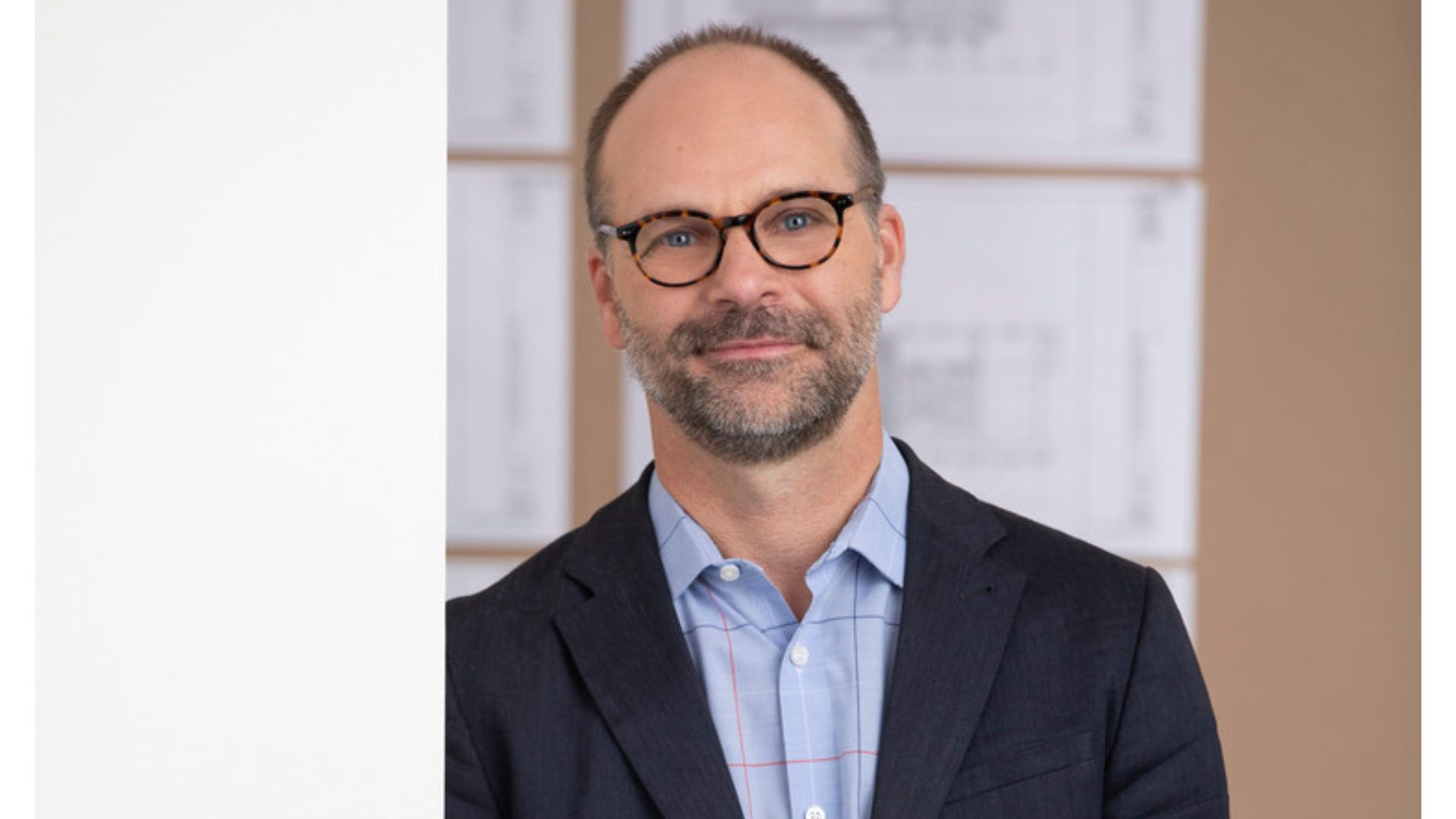
Swanborn has created a diverse portfolio of award-winning projects, including higher research and academic facilities, medical and health sciences education buildings, healthcare facilities, and K-12 schools. | Photo Credit: Courtesy of CO Architects
By Lindsey Coulter
Arnold Swanborn, AIA, LEED AP, is one of the newest members of the School Construction News Editorial Advisory Board. Swanborn is Design Principal at CO Architects in Los Angeles, and, after more than three decades in the industry, has created a diverse portfolio of award-winning projects, including higher research and academic facilities, medical and health sciences education buildings, healthcare facilities, and K-12 schools — ranging from 100,000 square feet to more than 2 million square feet.
Swanborn leads CO Architects’ design direction. His work focuses on connecting people to place through the design of sustainable buildings that are responsive to their environments. His widely publicized work includes the Health Sciences Innovation Building, Health Sciences Education Building, and Biomedical Sciences Partnership Building for the University of Arizona and the Loyola Marymount University Life Sciences Building. Notable under-construction projects of his include the Wichita Biomedical Campus, the Arizona State University Health Building, and the University of Texas at Austin Autry C. Stephens Engineering Discovery Building.
A native of the Netherlands, Swanborn’s architectural influences include Mies van der Rohe, Le Corbusier, Louis Kahn, and Frank Gehry. Visual artists he finds inspiring include Frank Stella and Dutch master Vermeer. He received his Master of Science in Advanced Architectural Design from Columbia University, and his Bachelor of Architecture from the University of Southern California.
School Construction News talked with Swanborn about his design philosophy and how he applies sustainable principles across projects. Watch for more of this interview in the upcoming K-12 issue of School Construction News, introducing all new Editorial Advisory Board members.
SCN: What drew you to architecture initially, and how did your early experiences shape your design philosophy?
Swanborn: The work I do today has a lineage that goes back to growing up in Holland. I can’t remember a time when I was not drawn to crafting, making, and creating. As with many young kids, it started with Legos, the ubiquitous blocks from which you could create anything you dreamed of. I was obsessed. My creative outlets expanded to more intricate and delicate creations—functioning balsa-wood airplanes, model cars. These creative outlets were fostered by a grandfather who built sailboats and furniture and a father who was trained as an architect and always tinkered around the house. Those nascent influences grew into an appreciation of tactile experiences and well-crafted objects and spaces. The transition into the field of architecture was seemingly preordained, natural. The obsession and drive to design and build that started as a young kid continues to this day. My work explores light and tactile surfaces, and is driven by narrative and the experiential.
SCN: Your portfolio spans research, academic, healthcare, and K–12 projects. What common design principles carry across these different building types?
Swanborn: At its core, architecture is the artistic expression of an intentional set of experiences. So no matter what the program, for me it starts by narratively constructing those experiences. Since the program, location, and climatic conditions vary project to project, the outcome is always bespoke to the circumstance. In a way these building projects are like cities. We have to move people, give them places to learn, work, and heal, and do it in a way that inspires them to be at their best. Connecting to place, time, and nature is what drives the work through the use of daylight to form and define space, surface, and user experiences. I like to think of light as a material. Free, sustainable, and ever-changing, it creates dynamic and surprisingly new experiences to delight and provide joy in a variety of environments: education, healing, workplace. We don’t see light until it reflects and washes across a surface. Light creates a mystique when you put it in the right place on and in a building. Light is the life of a building.
SCN: Sustainability is a core focus of your work. How do you approach sustainable design in large, complex institutional buildings?
Swanborn: At the highest level we strive to create 100-year buildings. Designing buildings to be flexible and adaptable over time is the most sustainable measure. Our planet has limited resources; we need to think more holistically about the crafting and making of buildings. For me that begins with understanding where it is in the world vis-à-vis the climate. Then look for passive solutions for daylighting, ways to control solar exposure with an eye on reducing the EUI (energy use index). These have been the basics. Now, embodied carbon and electrification are the big focuses for reducing the initial and operational carbon footprint. For example, we start every project by exploring mass timber, but look at all of our choices with a lens toward carbon neutrality. Hence, while we can design a stunning double-skin glass wall, the question of appropriateness is always at the forefront. The answer is more reasonably found in a vernacular that is regionally appropriate.