
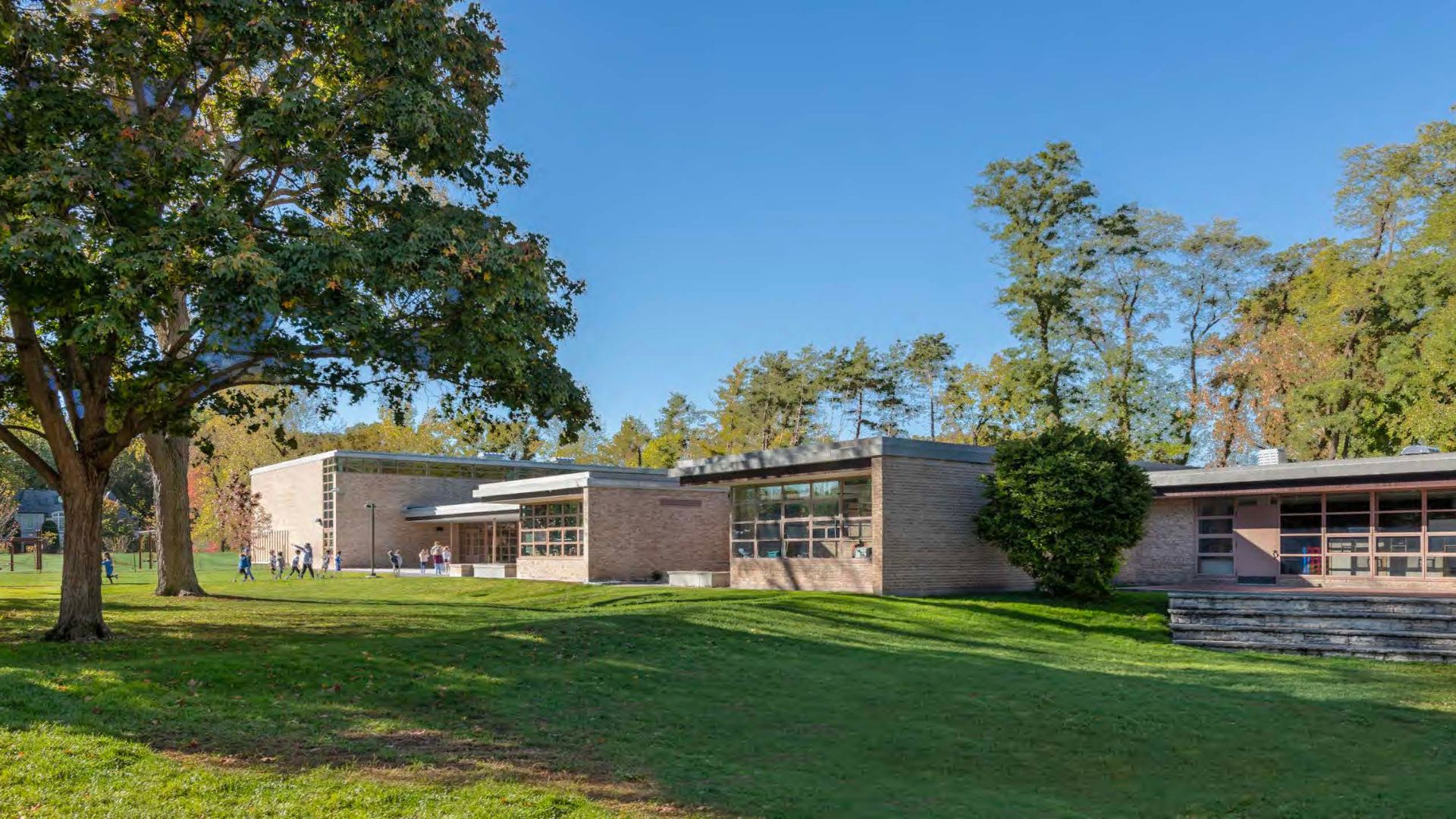
The American Institute of Architects named Crow Island School the most advanced elementary school in the country upon opening, later awarding the project its prestigious Twenty-Five Year Award in 1971—and led to the school’s designation as a National Historic Landmark in 1990. | Photo Credit (all): James Steinkamp Photography
By Rick Young, AIA, LEED AP
The Crow Island School in Winnetka, Illinois was designed and built in 1940, by a team of architects including Larry Perkins (of Perkins, Wheeler & Will) and Eliel and Eero Saarinen. The first project of what would later become Perkins&Will, Larry Perkins rooted the design in the progressive educational principles that would become a model for school design in the modern era. He achieved this through extensive classroom observation and with the support of the school’s superintendent and education reformer, Carleton W. Washburne. The resulting school is a piece of living, breathing history which earned immediate recognition. The American Institute of Architects named it the most advanced elementary school in the country upon opening, later awarding the project its prestigious Twenty-Five Year Award in 1971—and led to the school’s designation as a National Historic Landmark in 1990.
The classroom layout, considered a monumental step forward in education at the time of construction, is still used as inspiration for today’s contemporary classrooms. With the completion of construction in 2025, architects Perkins&Will, along with Bulley & Andrews Construction, finalized a multi-year expansion and renovation of Crow Island School. The project was designed to respect the past and serve as a seamless extension of the existing school, proving that thoughtful design can honor a historic legacy while meeting modern construction standards.
Extending the Campus While Preserving Scale
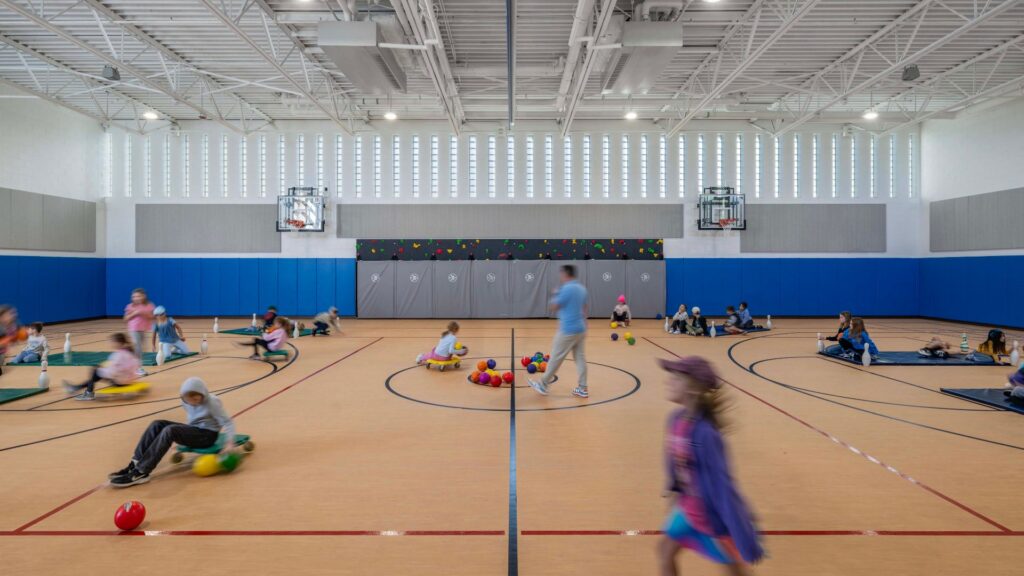
The project’s addition grows from this history. A key early decision was to connect the expansion of the new gym and classrooms to the 1954 addition. The new addition matches the roof heights of the existing four wings, maintaining the low profile and horizontal massing. New classrooms utilize the same L shape, allowing for a primary instruction area and separate work area. The iconic wood paneled walls in the original 1940 building and 1954 addition continue into the 2025 addition, giving the interior warmth. Entrances to the new classrooms emulate the 1954 addition with display cases at the entries with expanded clearances for accessibility.
Recreating Chicago Common Brick
The new addition’s exterior is an extension of the existing 1954 façade in detail, profiles, and materials. One of the many challenges the design team faced was matching the existing brick. Both the original 1940 building and the 1954 addition were constructed of Chicago Common brick, which differs in size and production techniques from modern ASTM tested brick. Historic Chicago Common brick measures 8-1/2” when stacked 3 courses tall rather than 8″ for modern brick. Chicago Common brick was extruded and cut horizontally, which leads it to having very particular texture on its end faces, and the varying particulates in the clay give the bricks a distinctive non-homogeneous coloring. A great deal of time and energy was invested into finding a suitable contemporary brick that would match the color, texture, and general feel of the existing Chicago Common, resulting in a harmonious transition from the existing building to the new addition.
Modern Performance Within Historic Constraints
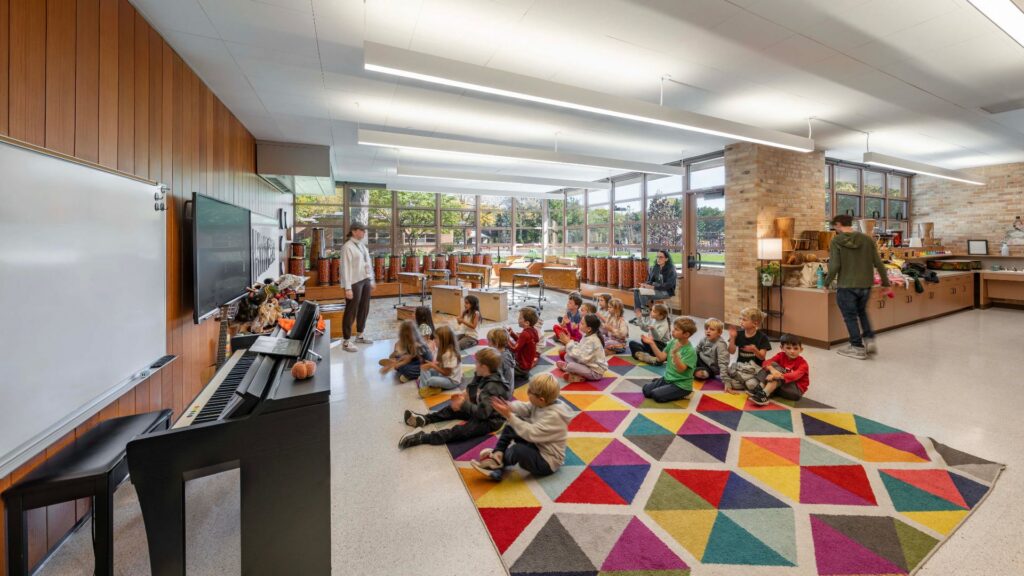
In 2003 the single pane windows throughout the building were replaced with steel framed insulated glazed windows. The team explored duplicating those steel windows; however, they could not meet current energy performance requirements. While thermally broken steel windows options are available, they were also prohibitively expensive. After many iterations with the design team, consultants, and the client, the team settled on an attractive combination of thermally broken storefront and aluminum windows, giving the same effect as the existing steel windows, but with improved performance to meet current energy standards at a fraction of the cost.
Another key element of the renovations included adding air conditioning throughout the historic building. Through extensive investigation of the existing building, the design team was able to thoughtfully coordinate routing of new hydronic piping and condensate lines with minimal impact on the existing spaces. Where work was performed in the existing 1940 and 1954 wings, the construction team went to great measures to carefully remove, salvage, and reinstall the old growth wood wall paneling. Similarly, new security systems were installed throughout the facility. New cross-corridor doors were added to isolate sections of the building in the case of a lockdown. These interventions were carefully detailed and executed to minimize the visual impact apparent to its occupants.
Building Consensus Around a Landmark
Given the sensitivity for this beloved school, all visual impacts to this historic facility were carefully analyzed, graphically represented, and shared with the School District, Board of Education, local Stewardship Group, as well as the Illinois State Historic Preservation Office. At every stage, the design team shared not only the proposed solution, but also the rigorous investigation exploring every option leading to that point. It was through this effort that made all these invested voices feel like a genuine part of the process and allowed the team to build consensus around the best solutions to meet the modern needs of this operational school while honoring its historic legacy.
Rick Young, AIA, LEED AP, is Senior Project Manager and Associate Principal with Perkins&Will.