
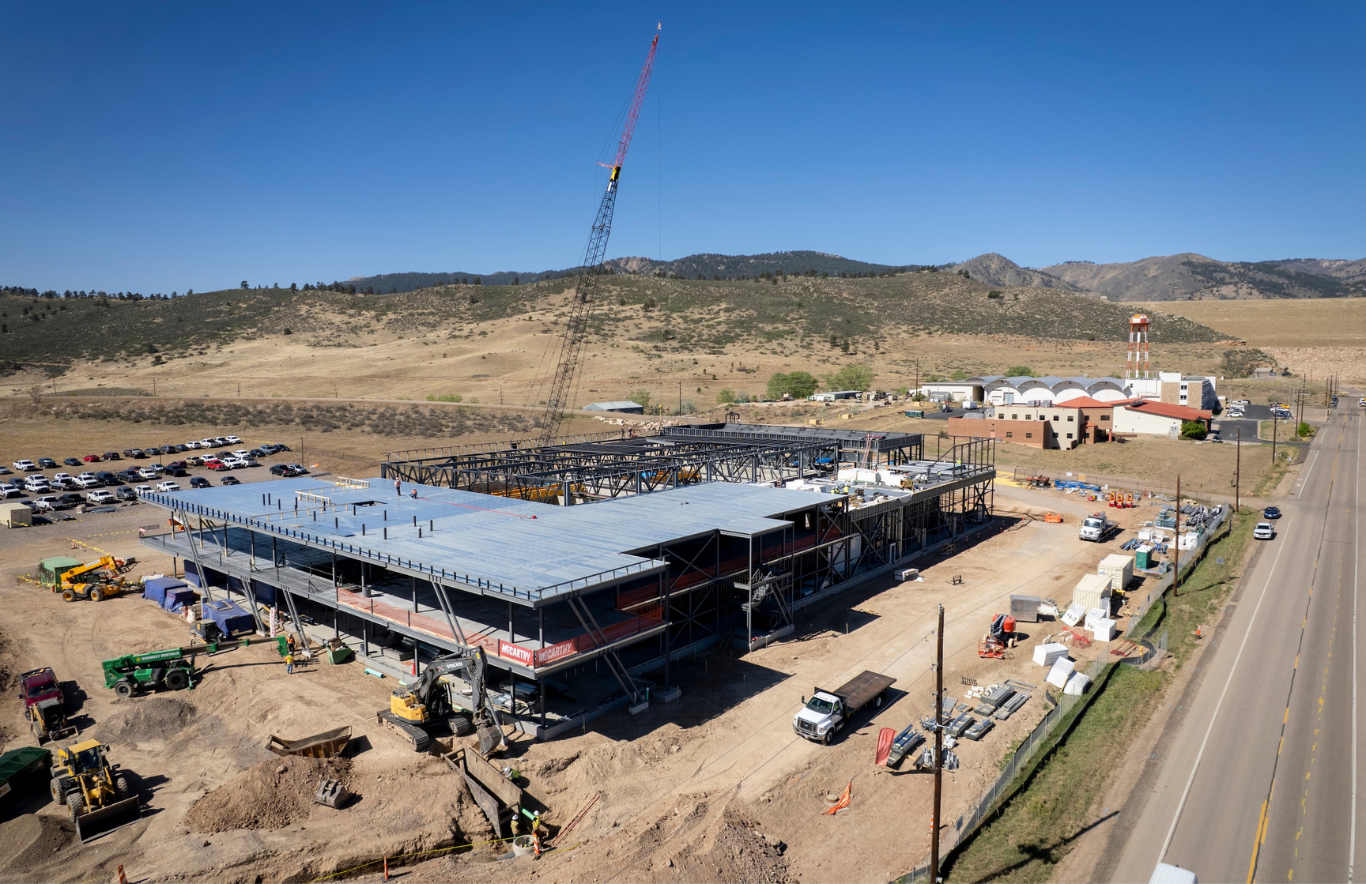
When complete, the ATLAS Facility is expected to house one of the most powerful laser systems in the world, supporting research in fusion energy, medicine and fundamental science. | Photo Credit (all): Courtesy of McCarthy Building Companies
- Colorado State University held an April 24 topping-out ceremony for the ATLAS Facility, a two-story laser research building on the Foothills Campus.
- The project team completed the structural steel frame for the 77,626-square-foot facility, with participants signing the final beam before placement.
- The $150 million public-private partnership includes CSU and Marvel Fusion, with additional support from the U.S. Department of Energy and other sources.
- Substantial completion is scheduled for December 2026, and the university anticipates an official opening in 2027.
- The specialized interior build-out will include cleanrooms and vibration-sensitive labs designed for high-performance laser research.
FORT COLLINS, Colo. — Colorado State University marked a major construction milestone April 24 with a topping-out ceremony for the Advanced Technology Lasers for Applications and Science, or ATLAS, Facility, a project officials say will become one of the world’s most advanced laser research centers.
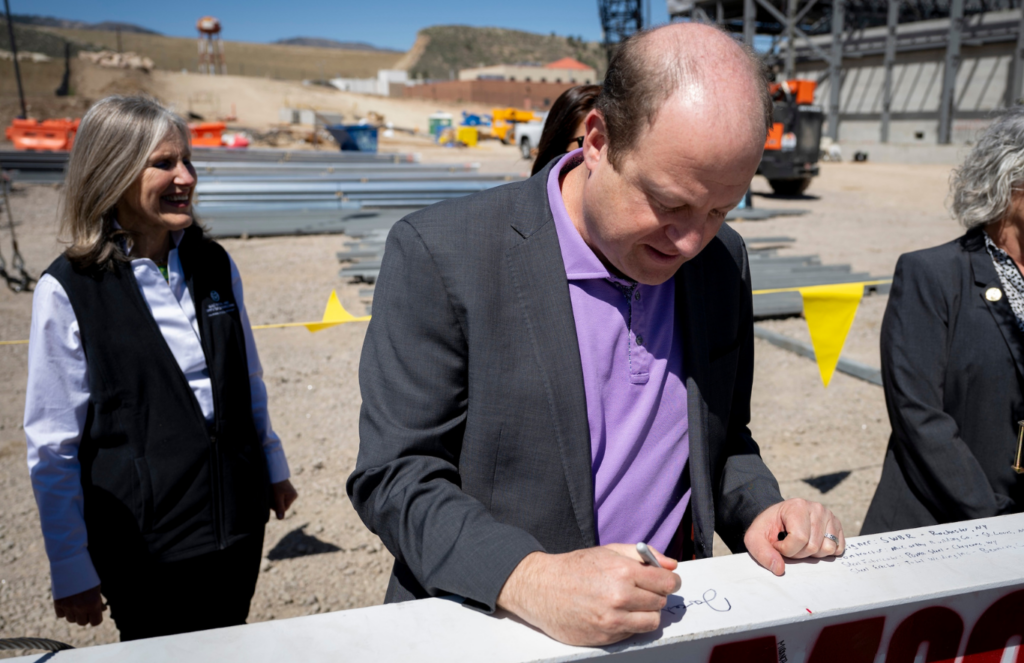
The event recognized completion of the structural steel frame for the two-story, 77,626-square-foot building now rising on the university’s Foothills Campus near the Department of Atmospheric Science building. During the ceremony, faculty, students and staff were invited to sign the final beam before it was placed atop the structure, a longstanding construction tradition symbolizing progress and safety.
“As the United States works to lead in areas like fusion energy and directed-energy technologies, facilities like this are essential,” said Cassandra Moseley, Vice President for Research at CSU. “ATLAS will serve as a critical testbed, bringing together academia, industry and government to accelerate innovation, strengthen energy security and ensure our competitiveness on a global stage. I’m grateful for our industry and federal partners who have been — and will be critical in making this vision for scientific progress a reality.
When complete, the ATLAS Facility is expected to house one of the most powerful laser systems in the world, supporting research in fusion energy, medicine and fundamental science. University leaders have said the project is intended to position Colorado State as a global hub for next-generation laser science and related technologies.
The project is being delivered through a $150 million public-private partnership involving Colorado State University and Marvel Fusion, with additional support from the U.S. Department of Energy and other funding sources. The facility was developed by Tetrad Real Estate, designed by architecture and engineering firm SWBR, and is being built by McCarthy Building Companies.
Ground was broken on the project in fall 2024. Substantial completion is scheduled for December 2026, with an official opening anticipated in 2027.
With the steel frame now in place, construction will shift to enclosure of the building exterior, followed by installation of mechanical, electrical and plumbing systems. Crews will then begin the specialized interior build-out required for high-performance research operations, including cleanrooms, vibration-sensitive laboratories and precision environments needed to support advanced laser equipment.
Facilities of this type typically require stringent environmental controls to maintain stable temperature, humidity and air quality, while also minimizing vibration and electromagnetic interference that could affect experiments. Those technical requirements often make research laboratories more complex than conventional academic buildings.
University officials have said the ATLAS Facility will expand Colorado State’s long-standing leadership in laser and plasma science while creating opportunities for faculty recruitment, student training and industry collaboration. The project also is expected to attract visiting researchers and federal research partnerships.
Fusion energy research has drawn increasing international attention in recent years as governments, universities and private companies pursue technologies that could provide large-scale carbon-free power. Laser-based systems are among several approaches under development to achieve controlled fusion reactions.
Beyond research, the facility is expected to generate economic benefits for the Fort Collins region during both construction and operation. Large capital projects typically support jobs across the design, engineering and construction sectors, while new research infrastructure can create longer-term demand for technical talent, suppliers and related business activity.
The topping-out ceremony also highlighted continued momentum on Colorado State’s Foothills Campus, which has become a center for research initiatives tied to engineering, atmospheric science, energy and technology.
Once operational, ATLAS is expected to serve as a flagship asset for the university and a prominent addition to the state’s research infrastructure. Officials say the facility’s combination of scale, technical sophistication and partnerships could make it a significant contributor to scientific discovery for years to come.