
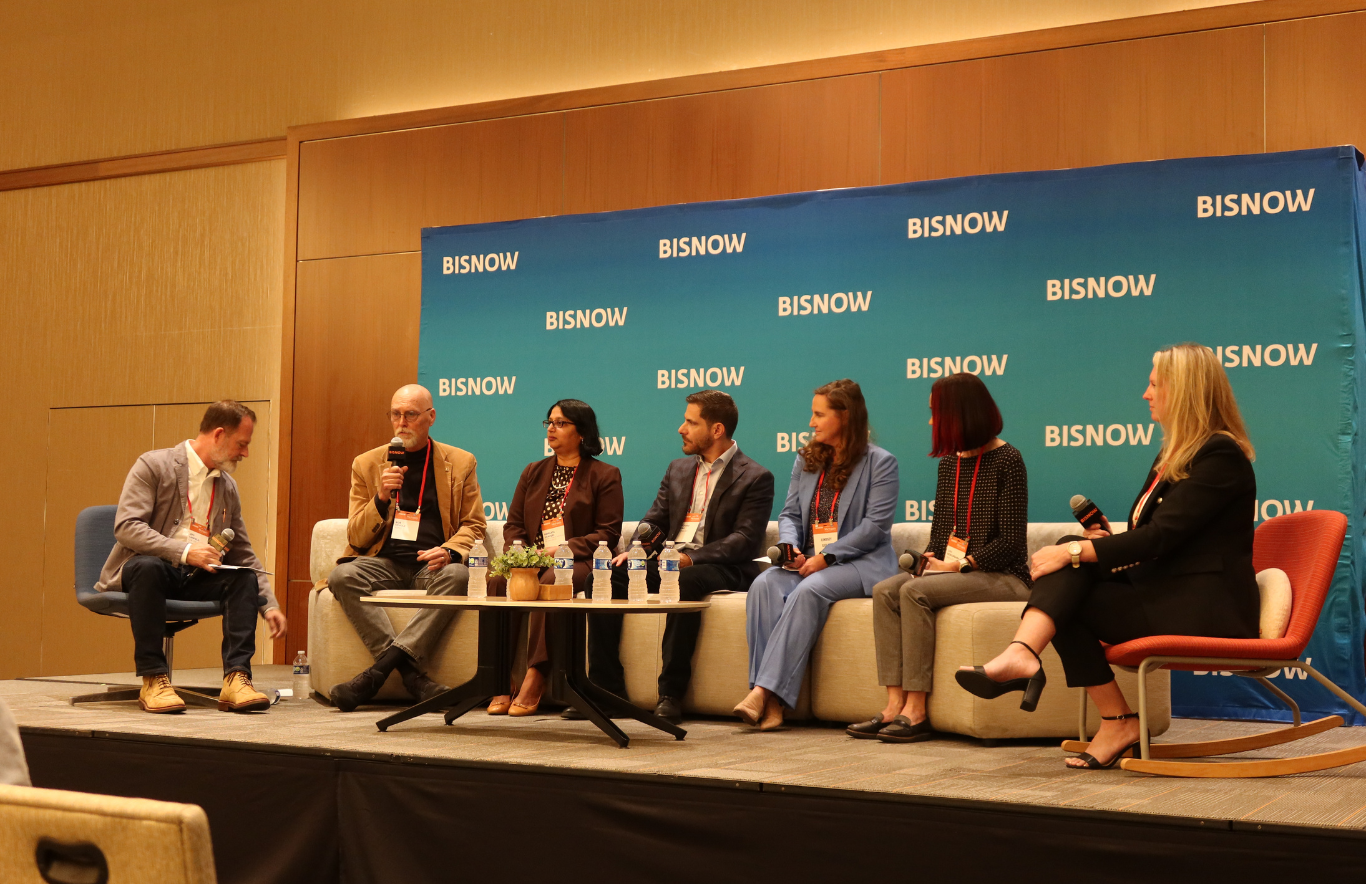
Panelists noted a distinct shift in how institutions are thinking about the relationship between unit size and community space.
By Sarah Clow
As student housing is a growing part of the higher education design and construction conversation, School Construction News attended the Bisnow San Diego Student Housing & Higher Education Conference on May 13. The event brought together developers, university administrators, architects, and construction leaders, with a focus on balancing growth with affordability and changing needs and expecations regarding student experience. Across the board, panelists agreed that institutions are rethinking the traditional student housing model, and for many students next-generation housing options are non-negotiable.
Building For All — Balancing Housing Growth with Affordability
There is a growing student housing crisis in San Diego, where most universities can only guarantee housing for first- and second-year students. Panelists were candid about the structural barriers to building more attainable housing — and financing topped the list. When asked to identify the biggest hurdle — financing, land, or approvals — nearly every panelist pointed to financing but also pointed to strategies for bringing costs down. Chief among them: increasing density.
Adding more beds to existing builds helps spread construction costs across more units, improving the economics of a project without sacrificing quality. Delivery methods also came up as a key lever, with progressive design-build highlighted as an effective tool for faster, more cost-efficient delivery.
Panelists noted a distinct shift in how institutions are thinking about the relationship between unit size and community space. Square footage per student is shrinking, while investment in recreation and amenity spaces is growing — a deliberate strategy to push students toward shared community while also keeping per-bed costs down. When asked about must-have amenities for higher education projects, panelists pointed to outdoor programmatic space and collaborative, community-focused interiors as essential.
Speakers included: Hemlata Jhaveri, Senior Associate Vice Chancellor at UC San Diego; Bob Schulz, University Architect and Associate VP of Real Estate at SDSU; Abbie Hawkins, VP of Development at The Michaels Organization; Lindsey Sielaff, Operations Manager at Hensel Phelps; Richard King, Principal at Gensler; and Lisa Norombaba, Executive Director of Wesley House.
Panel 2: From Dorms to Destination — Redefining the Student Living Experience

Today’s students value quality over quantity, and the student housing industry is responding.
The ongoing shift toward wellness-focused design is bringing spas, fitness centers, relaxation spaces, and mental health-supportive environments into student housing. Interestingly, these offerings are no longer considered amenities — they’re expectations. Panelists noted that younger students are willing to trade square footage for higher-quality finishes and thoughtful design, a trend that is reshaping unit mix strategies toward smaller one- and two-bedroom configurations.
Landscape and outdoor space took center stage, particularly in the Southern California context. Panelists from McCullough Landscape Architecture emphasized the growing importance of connection to nature, flexible outdoor programming and visibility — both for community building and for safety. Transparency and sightlines in outdoor spaces were called out as important design tools for creating environments where students feel secure.
However, the panel pushed back on trend-chasing in amenity design. For example, rather than including a golf simulator — a shiny amenity that doesn’t hold long-term value — panelists emphasized creating genuine “third spaces” for socialization: areas that aren’t over-programmed, allowing students to use them organically.
Walkability and bike-ability also emerged as a priority, with several panelists advocating for pedestrian-focused campus design as a means of supporting both student health and affordability by reducing transportation costs.
The panel also highlighted an interesting tension in the market: while many developers are moving toward smaller bed counts and higher-end amenities to attract students willing to pay a premium, San Diego Community College District is taking a different approach — building higher-density housing with fewer amenities to maximize access for lower-income students. Both strategies reflect the breadth of need in the market.
On the technology and security front, panelists pointed to smart package and food delivery lockers as an increasingly expected feature — a practical response to the realities of how students live today.
Finally, the Southern California advantage was hard to ignore. The indoor-outdoor lifestyle is a genuine differentiator in design, and solar energy adoption is accelerating. Core Spaces highlighted a project near UCSD where rooftop and parking structure solar arrays are expected to cover the majority of the building’s energy costs — a compelling case for sustainability as both a values play and a financial one.