
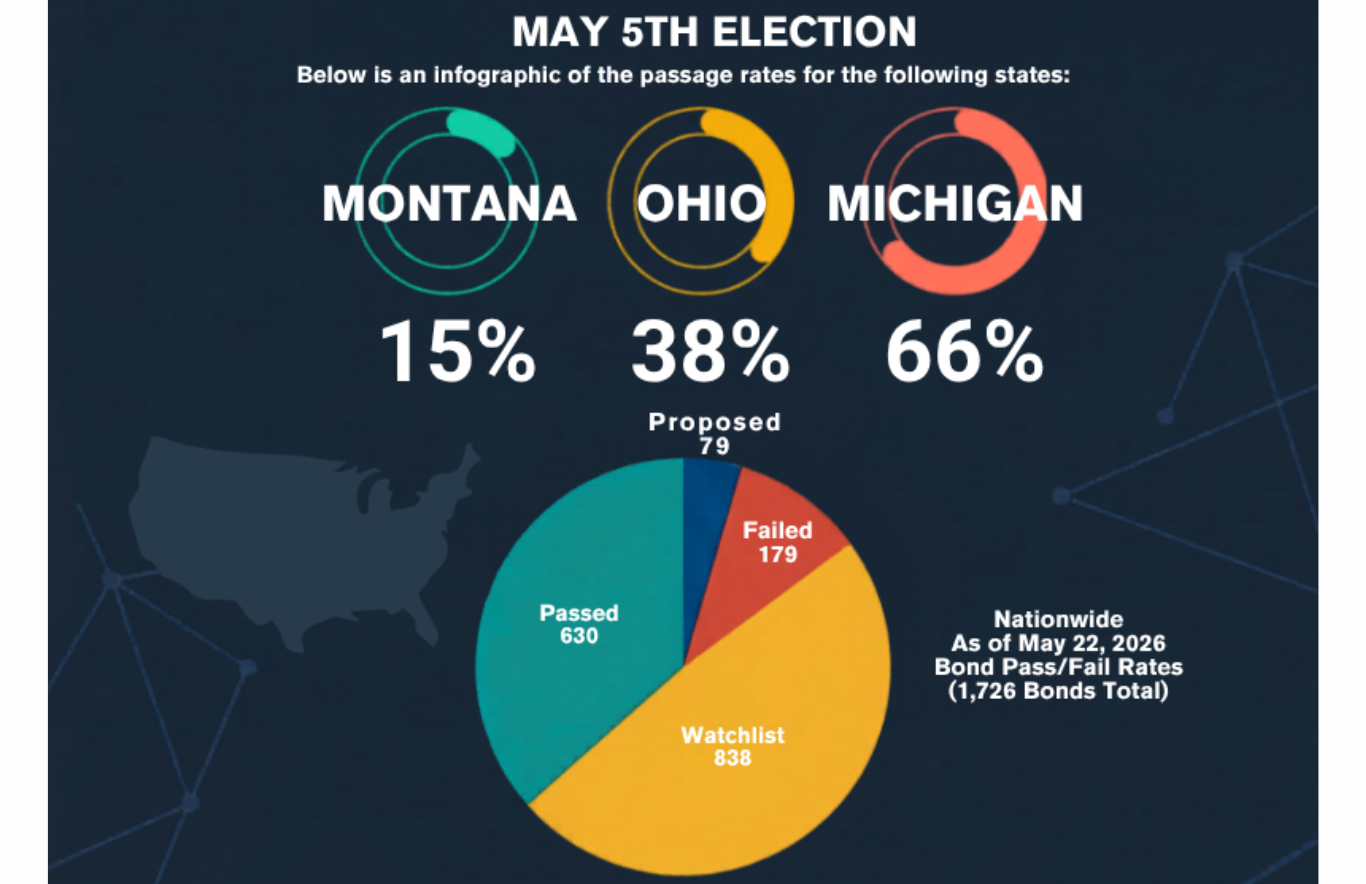
SchoolBondFinder is currently tracking roughly $49 billion of opportunities, with many of the organization’s Watchlist items having no money attached yet. | Photo Credit (all): SchoolBondFinder
By Petra Sucher
SchoolBondFinder specializes in tracking K-12 capital project bonds across the nation. The platform monitors school district bond initiatives across key stages, providing stakeholders with crucial data on project scope, financing, and voter outcomes. In March, SchoolBondFinder shared first-quarter updates and referendum insights for the 2025 and 2026 election cycles.
The research team is actively updating the platform with the latest election results with a “boots on the ground” approach. Most updates for referendum votes are reflected within 24 to 72 hours of passage.
Read more for an in-depth look at April and May results, highlighting essential insights for the 2026 K-12 bond market.
An Overview of April Elections
 For April a majority of elections occurred on April 7. Approximately 80% of the bonds (120 out of 150) passed, whereas 30 failed. The total value for both passed and failed bonds amounts to $4B. Most districts focused on infrastructure and safety. Missouri and Oklahoma were the most active states this month. Missouri had 64 bonds and Oklahoma had 39 bonds.
Key Districts:
Wayzata, Minn. ($450,000,000):
- Scope: New construction of a public elementary school and a middle school, as well as classroom and lab additions at the high school, kitchen and cafeteria expansions, and gymnasium additions.
- Status: Passed
Tulsa, Okla. ($276,000,000):
- Scope: Extensive renovations to an existing public school, including new classrooms, kitchens, ADA compliance upgrades, HVAC systems and roofing across multiple sites.
- Status: Passed
Howard-Suamico, Wis. (147,000,000)
- Scope: New classroom additions and gymnasiums at three elementary schools, plus Career and Technical Education labs and performing-arts spaces at the high school.
- Status: Passed
Dallas Independent School District Passes $6.2 Billion in Bonds
On May 2, voters approved 92 of 118 propositions for a passage rate of 78%, which is consistent with national trends. Many Texas school districts had multiple propositions on the ballot. In Texas 10 out of 26 failed, most having to do with athletic propositions.
Dallas Independent School District passed its bond package worth $6.2 billion, the largest in Texas history. Proposition A will fund new construction to replace 26 schools and expand existing schools, adding classrooms to eliminate portables. It will also fund efforts to:
- Renovate and modernize every campus across the district
- Remove the district’s 700 remaining portable classrooms
- Enhance safety and security at all campuses
- Upgrade school furniture, student technology, and transportation, including new school buses
- Improve physical education facilities and repair swimming pools
The bond package will be broken up into four propositions to ensure transparency and flexibility. This bond package will leave a generational mark not just for the funding amount, but for the scope of the project.
Movement in Michigan, Ohio and Montana
There were 79 propositions on the ballot for May 5, most in Michigan, Ohio, and Montana with a mix of bonds and levies. For reference, a school bond election is a bond issue used by a public school district, typically to finance a building project or other capital project. These measures are placed on the ballot by district school boards to be approved or defeated by the voting public or taxing authority. A levy is a short-term, local property tax passed by the voters of a school district that generates revenue for the district to fund programs and services that the state does not fund. Levies are used mostly for operational expenditures.
In total, 43 propositions with a value of $2 billion passed on May 5, whereas 36 propositions worth $1.6 billion failed. The number of bonds passed represents a passage rate of just 54%, lagging historic national trends.
A recent trend observed by SchoolBondFinder researchers this year involves districts requesting earned income tax levies to fund construction projects, either by itself or combined with another funding source like a bond. Researchers typically see this for operating levies, but districts in the State of Ohio asking for this to accommodate their construction needs is new. Districts may attempt to attract older voters by utilizing earned income tax levies, as these measures do not impact that demographic in the same way increasing property taxes do. There were three earned income tax levies on the ballot this month in Ohio and all three failed.
Other May Bond Decisions
Voters considered 16 total propositions during this election cycle, resulting in six passing and 10 failing. Bonds were approved in Mississippi, Massachusetts, Nebraska (2 districts), Minnesota and West Virginia. With most of the propositions focused on new construction.
- Passed Amount: Totaling $498,285,000
- Failed Amount: Totaling $342,648,950
There were a total of 127 propositions that went to vote on May 19. Of those, 113 passed for a passage rate of 88%. The majority of those on the ballot occurred in New York. A total of 94 bonds passed, totaling over $1 billion in New York.
Factors Influencing District Priority Shifts
In addition to the well-known challenges of declining enrollment and district operational difficulties, several other factors are at play school consolidations, expiration of Cares Act funding, voter resistance to specific measures and a downward trend in birth rates. These changes suggest districts may be pivoting priorities to better serve local needs and moving away from projects fueled by federal programs.
Key Focus Areas for Passed Bonds
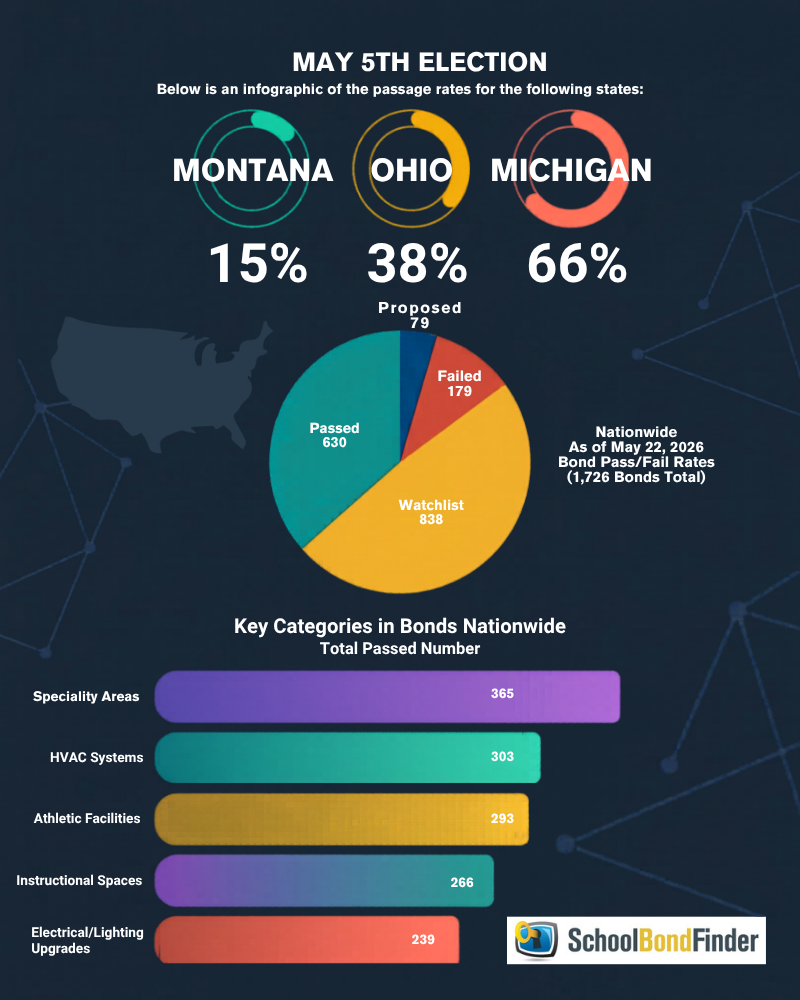
Despite these challenges, passed bonds are still showing strong support for key focus areas, such as specialty areas, HVAC systems, athletic facilities, instructional spaces, and electrical and lighting upgrades.
SchoolBondFinder is currently tracking roughly $49 billion of opportunities, with many of the organization’s Watchlist items having no money attached yet. Researchers are tracking more than 1,726 bonds as of May 22. Elections in June and August are around the corner and will be featured alongside the 2026 Q2 updates and researcher insights this summer.
Petra Sucher is the Marketing Engagement & Analytics Manager for SchoolBondFinder.