

By Lindsey Coulter
Dorian Maness, GGP, is a Senior Project Manager and Mechanical Engineer for the Education Division of Matern Professional Engineering in Maitland, Fla. Focusing on project management and mechanical systems design, Maness delivers innovative, tailored HVAC systems that allow students and educators to focus on learning, while giving school leaders operational peace of mind.
“School environments are often occupied and require continuous, rapid maintenance,” Maness said. “So, there’s a balance to be struck between what the owner wants, what mechanical system success needs to meet the functionality of the school, and what the maintenance team can maintain to ensure the system operates effectively.”
Maness joined the School Construction News (SCN) Editorial Advisory Board in 2025, bringing valuable expertise in engineering and mechanical systems for K-12 and higher education. As school facilities must contend with more extreme temperatures, changing codes, shifting maintenance budgets and higher performance expectations, Maness spoke with SCN about what it takes to design and deliver systems that work and last.
SCN: What’s your philosophy on balancing performance and cost in HVAC design?
Maness: Each project is unique and it’s critical we have the right conversations to figure out what works within the framework of the project and the owner. My philosophy breaks down to “Make it make sense.” There is a fine line between the performance of a system and the cost of getting that performance out of the system. Clients often approach a project with the notion that they want the highest performance system. However, there is a [financial] tradeoff. As an engineer and project manager, it’s my job to understand things like budget and Life Cycle Costs to be able to have conversations with the owners or clients to guide them in a way that makes sense for their needs and the needs of their school. Sometimes I’m able to design a cool high-performance system and give them the most efficient HVAC system, which can save money over time or get tax rebates for the district. At other times, due to first costs and budget, we must design a more robust system that is more easily maintained and that the district is more familiar with.
SCN: What innovations in mechanical system design are most promising for schools?
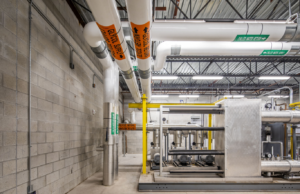
Maness: Schools are becoming more complex. They’re constantly changing and offering many new programs that used to be available only in colleges or technical schools. Mechanical equipment has become smaller and more powerful, allowing us to support various programming spaces, such as auditoriums, large gymnasiums, welding labs, automotive labs and robotics labs. Along with mechanical equipment, innovations in programming and BAS control have also been crucial to the advancement of how mechanical systems operate. Adjusting to various school loads, allowing owners to see real-time alarms and failures on the equipment, are all innovations that have allowed us to change the way we design schools and give value back to the owners and clients.
Additionally, in Florida, high temperatures and high humidity will always drive the mechanical system design in schools. Ensuring that the mechanical system has capacity to cool all spaces as required will become more challenging as the climate increasingly gets warmer or stays warmer longer. However, one trend I’ve seen is mechanical equipment becoming more efficient and better at handling high humidity or high temperatures. Utilizing this equipment in newer designs will be crucial to keeping up with future demands.
SCN: What’s a misconception owners often have about mechanical design?
Maness: Owners underestimate the cost and space required to house mechanical systems. Most owners care first and foremost about how their building looks aesthetically, not about the space inside the building that no one sees. Ironically, this is the space that mechanical engineers care about the most: the cavity above ceilings, the space on the roof, or mechanical rooms on a floor plan that no one will ever go into or see. These are the areas that house our ductwork and air handlers, chillers, exhaust fans and many more pieces of mechanical equipment that are crucial to our design. Often, I hear how surprised they are about how many mechanical rooms we need on a floor plan or how much space we need outside for our chillers. This makes it crucial for us to be involved in early talks with the owner and architect when designing the footprint of a new building.
SCN: In what other ways do you collaborate with architects and planners to optimize student comfort?
Maness: I collaborate very closely with architects and planners to be sure the overarching designs maximize student comfort. While the architects design the layout of a school in respect to hallways, classrooms, gymnasiums, and more, it’s my job to ensure that our mechanical design maintains the various spaces and makes them comfortable — no matter what the students are doing. The same type of mechanical system that serves a classroom wouldn’t be useful in a gymnasium or a cafeteria. Ensuring that these different areas of a school have the appropriate mechanical design is our most important job. Working closely with architects and planners is critical, and we communicate extensively about the spaces we need for all these different areas to ensure we can fit our equipment and have enough space above the ceiling for our larger ductwork.
SCN: What project taught you the most about energy-smart system design?
Maness: Whether it’s elementary, middle or high school, the first question is always about costs. Since most schools are supported by taxpayer dollars, cost savings and energy savings are always the first topics with owners. In my experience, high-school projects present the most opportunity to utilize high-energy saving designs because they are larger and have more diverse student programming; kitchens, culinary labs, chemistry labs, auditoriums, and gymnasiums are all high-energy use spaces. These unique spaces create opportunities such as Bi-Polar Ionization or Demand Control Ventilation, which are energy-saving designs that help to reduce energy and life cycle costs over time.
Get more weekly reports and timely updates by subscribing for free at schoolconstructionnews.com/subscribe.