
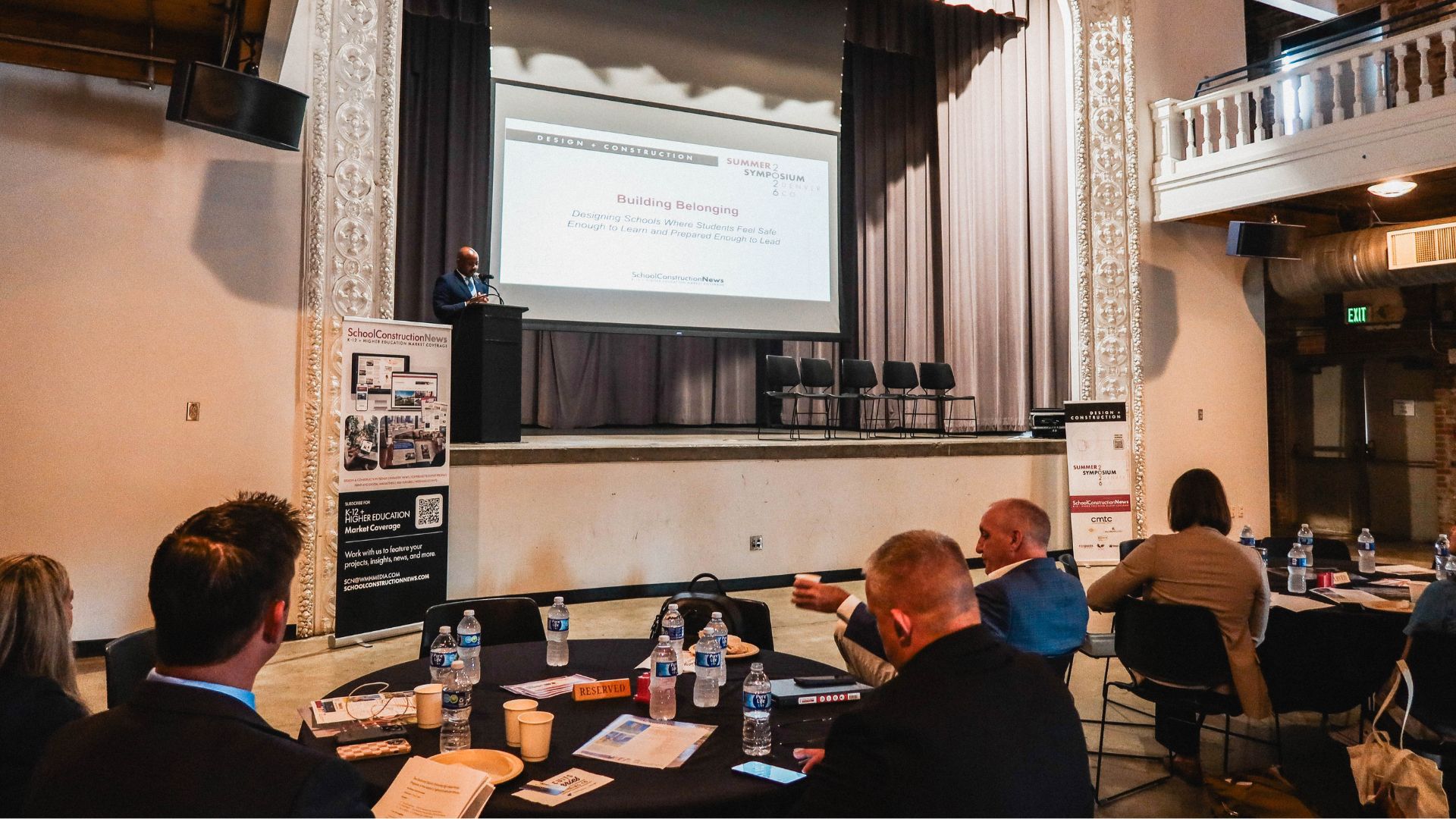
Dr. Drew Coleman provided the keynote speech at the recent School Construction News Design & Construction Symposium.
By Lindsey Coulter

A school building is more than the backdrop for education. It is where students develop relationships, teachers build community and young people begin to understand their place in the world. For Dr. Drew Coleman, Chief of Schools at Jeffco Public Schools, the physical environment is an important — and sometimes overlooked — part of that experience.
At the recent 2026 School Construction News Design + Construction Symposium, Coleman served as the keynote speaker. In his presentation, “Building Belonging: Designing Schools Where Students Feel Safe Enough to Learn and Prepared Enough to Lead,” Coleman examined how school environments can support belonging, safety and student success. The symposium brought together education leaders and the A/E/C community to explore the trends, challenges and projects shaping K-12 and higher education facilities.
In advance of the event, School Construction News (SCN) spoke with Coleman about his path from classroom teacher to district leader, what he has learned about the relationship between physical spaces and student outcomes, and why designing — or redesigning — a school should begin with how the people inside it experience that space.
SCN: What initially drew you to education?
Coleman: I believe education is a great equalizer. I had an awesome educational experience, with parents who viewed public education as very important and educators who invested in me. They pushed me academically, challenged me through activities and helped me build character.
I went into public education wanting to ensure that other people had that same experience. I realized my experience wasn’t the experience of all of my friends and counterparts, so I wanted everyone else to have that same opportunity.
SCN: How did your classroom experience shape the way you think about learning environments?
Coleman: Once I became a teacher, I realized education was more than putting standards and information in front of students. Students have to understand that we care about them.
I taught in Title I schools and some of our most impoverished schools, where buildings were often old and classrooms hadn’t received much investment. I wanted my students to have the kind of experience I had, so I invested in my own classroom.
A college professor once told me, “Your classroom should make your students feel like home.” I created little nooks and reading corners with a couch and bookshelf. I would put a lamp there. It was about reminding students what reading could be like and creating a space where they felt comfortable.
SCN: What have you learned about the relationship between belonging, the physical environment and student success?

Coleman: When a leader creates a sense of belonging, educators take pride in their space. I’ve worked in old buildings where educators were given the ability to make modifications and updates to their classrooms. They made their classrooms their own.
That translated to the students. They took ownership and pride in their classrooms, too. When students feel safe, feel like they belong and feel like they matter, it makes a difference. I’ve seen that reflected in academic outcomes.
The flip side is also true. If students walk into an old building where paint is chipping off the walls and they don’t have spaces that feel uniquely theirs, that has an emotional and mental impact on how they view education and learning. It also affects how they perceive how adults feel about them.
SCN: Does creating that environment always require a new building or major capital investment?
Coleman: No. I know money and finances are difficult for most schools and districts. New, innovative buildings are great, but it’s also about how we reimagine our current spaces so they align with 21st-century learning and what students need.
You can take an old home and fix it up on the inside. The same thing applies to schools. It isn’t necessarily about the neighborhood or location of the building. It’s about how we make the building and how we make students feel.
If students don’t feel they matter or don’t have a sense of belonging, it shows up in their academic outcomes and their behavior data.
SCN: How has your expanded role in safety and security changed how you think about the built environment?
Coleman: Safety and security is a unique space. There is the physical safety of the building—making sure we have the technical things in place so buildings are physically secure and feel safe. In Jeffco, we’ve done an extremely good job ensuring that our buildings have that sense of physical safety.
But there’s also a sense of safety and belonging. A building can be physically safe, but there can still be people in our communities who don’t feel safe.
That’s why listening is so important. We have to ask, “If you don’t feel safe, what would make you feel safe?” Then we have to determine what we can actually do.
SCN: What do you hope attendees took away from your symposium keynote?
Coleman: What we do in K-12 education is going to be so important, especially as we think about the next generation and what happens after high school. What we do in our schools makes a difference.
When we’re able to create an environment where students really feel that they belong, we’re able to decrease the dropout rate and increase the graduation rate.
The space matters. It matters more than people sometimes realize.
That’s why conversations between educators and the design and construction community are so important. Educators understand what students and teachers experience every day. Architects, engineers and contractors bring expertise about what is possible within the built environment. When those perspectives come together early and thoughtfully, we have an opportunity to create spaces that don’t just look good, but actually support the people who use them.