

By Petra Sucher
 As school districts nationwide grapple with aging infrastructure, evolving educational models and heightened community expectations, K-12 bond measures have become a critical mechanism for funding transformation. Beyond simple capital campaigns, these referendums reflect shifting priorities around safety, flexibility and long-term facility performance.
Recognizing the critical value of connecting readers with bond- and referendum-related insights, School Construction News is proud to announce a new partnership with SchoolBondFinder that will bring SchoolBondFinder’s expertise and capital project bond insights to School Construction News readers. SchoolBondFinder provides a data-driven lens into how districts are planning, proposing and delivering projects—offering stakeholders a clearer view of where investment is occurring and how those decisions are shaping the future of learning environments.
The School Bond Finder K-12 Bond Platform
SchoolBondFinder specializes in tracking K-12 capital project bonds across the nation. Our platform monitors school district bond initiatives across key stages, providing stakeholders with crucial data on project scope, financing, and voter outcomes.
- Watch List: Districts may be added to this list following initial activities such as a facilities study, demographic study, capital improvement plans review, or a feasibility survey.
- Proposed List: A bond is moved to this list once a school board officially approves a referendum for a vote. At this point, the vote date, official ballot language, use, and amount are finalized.
- Passed/Failed List: Updates on school bond referendum votes—both passed and failed—are typically available on our platform within 24 to 72 hours of the official results being released.
A Recap of 2025 Bonds
As the first quarter of 2026 wraps up it is important to look back at 2025 for reference. In 2025 SchoolBondFinder tracked $91 Billion worth of bonds. Approximately $69.2 billion passed, whereas $22.7 billion failed. The overall passage rate for 2025 was 75%, which aligns with the trend observed over the last few years. Our research team tracks school bond activity nationwide, with the highest total bond amounts recorded in Texas ($18.4 billion), California ($6.1 billion), Ohio ($3.5 billion), Washington ($3.4 billion), and Pennsylvania ($3.0 billion) in 2025.
Historic Trends
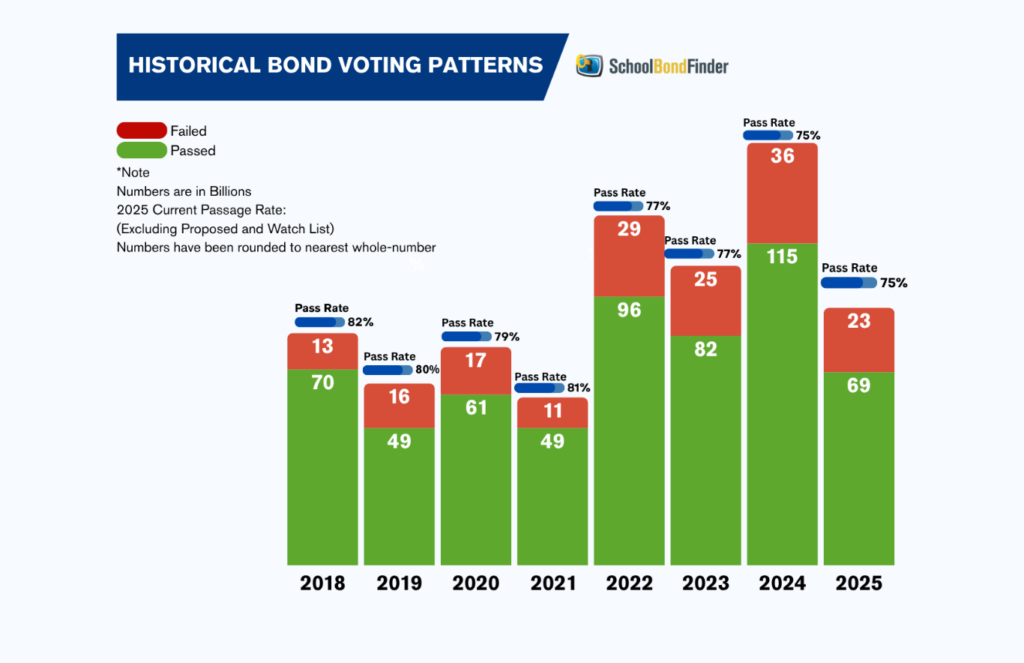
The chart below illustrates spending amounts for both passed and failed referendums over the past eight years. Election years typically show an increase in both the number and total value of bonds proposed, a trend often attributed to higher voter turnout during presidential elections, which can improve referendum passage rates.
An eight-year longitudinal analysis (2018–2025) highlights consistent trends in K-12 bond funding, offering insight into evolving educational priorities. During this period, bond measures most frequently supported the following project areas:
- Speciality Areas
- Instructional Areas
- Athletic Facilities
- HVAC SystemsElectrical and Lighting Upgrades
- Electrical / Lighting Upgrades
Given that most instructional buildings were built before the 1970s, it is no surprise that infrastructure upgrades are a top priority for school districts. Capital improvements continue to be focused on modernizing student learning environments. These spaces include classrooms, libraries, laboratories, and specialized facilities. The goal is student-centered learning, achieved through flexible environments that incorporate mobile furniture, integrated technology, and versatile layouts.
2026 Year to Date – First Quarter
As of March 2026, approximately $6 billion in K–12 bonds have been approved. Roughly 267 bond measures were tracked in the first quarter, resulting in a 70% passage rate. Approved bonds were concentrated primarily in specialty areas (ie cafeterias, sensory rooms, admin spaces), HVAC systems, and instructional spaces. The top three states (WA, KS, and IL) account for about 66% of the total bond amount passed in Q1.
2026 Bond Priorities
The SchoolBondFinder database is currently tracking a total of 1,478 bonds scheduled for 2026 and beyond, as of March. Approximately 117 bonds are scheduled to go to vote throughout the month of April, with more elections scheduled in May and June. The combined Proposed and Watch List bonds represent approximately $56 billion in potential opportunity.
K-12 School bonds are currently prioritizing construction, capital improvements, technology upgrades, and security enhancements. Many districts are seeking smaller, more targeted amounts for referendums, which may be more appealing to taxpayers and could be a more achievable strategy compared to large, multimillion-dollar bonds.
- Facility Longevity and Maintenance: There is a growing focus on facility longevity and maintenance over expansion. Renovation and repair projects are the most frequent, while new construction and major system/envelope upgrades represent higher-value contracts.
- Student-Centric Modernization: A significant portion of bond funding targets modernization and expansion of areas directly impacting student learning and extracurricular activities. This includes projects focused on flexible learning spaces, modern classrooms, and auditorium renovations, showing a high demand for multi-purpose furniture solutions.
- Infrastructure and Safety: Basic infrastructure remains a consistent priority. Projects related to safety/security and system/building envelope upgrades, such as HVAC replacement, roof repairs, and security show a commitment to the health, safety, and long-term goals of school facilities.
More Info and Insights to Come
Looking ahead, the trajectory of K-12 bond funding suggests a more strategic, targeted approach to capital investment—one that balances fiscal realities with the urgent need to modernize facilities. As districts continue to prioritize infrastructure resilience, student-centered design and operational efficiency, access to timely, reliable data will remain essential. Platforms like SchoolBondFinder are critical resources for A/E/C stakeholders, providing the in-depth insights necessary for better decision-making and efficient utilization of K-12 funding opportunities.
Watch for quarterly insights from SchoolBondFinder to learn more about upcoming opportunities.
Petra Sucher is the Marketing Engagement & Analytics Manager with SchoolBondFinder.