
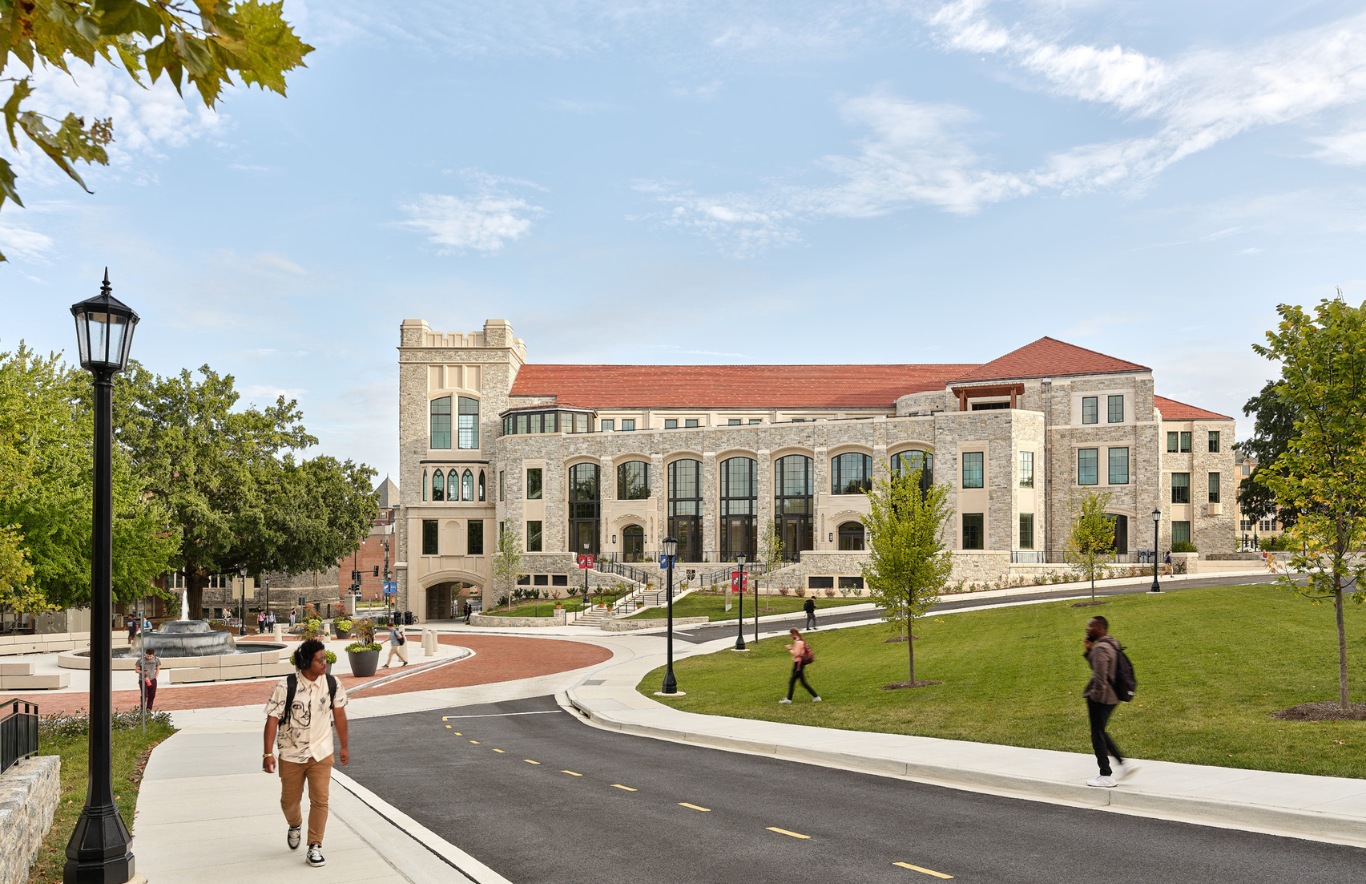
The Conway School of Nursing appropriately matches the scale and massing of neighboring buildings while embracing the Collegiate Gothic style that defines the Catholic University campus. | Photo Credit: Keith Issacs
By Lindsey Coulter
The Catholic University of America’s newly completed Conway School of Nursing marks a milestone in the university’s mission to address the national nursing shortage. Designed by RAMSA (Robert A.M. Stern Architects) in collaboration with Ayers Saint Gross, and constructed by Clark Construction, the more than 102,000-square-foot facility represents a cornerstone of the university’s campus master plan and embodies the Conway School of Nursing ethos: “Where High Tech Meets High Touch.”
A Gateway Campus Hub
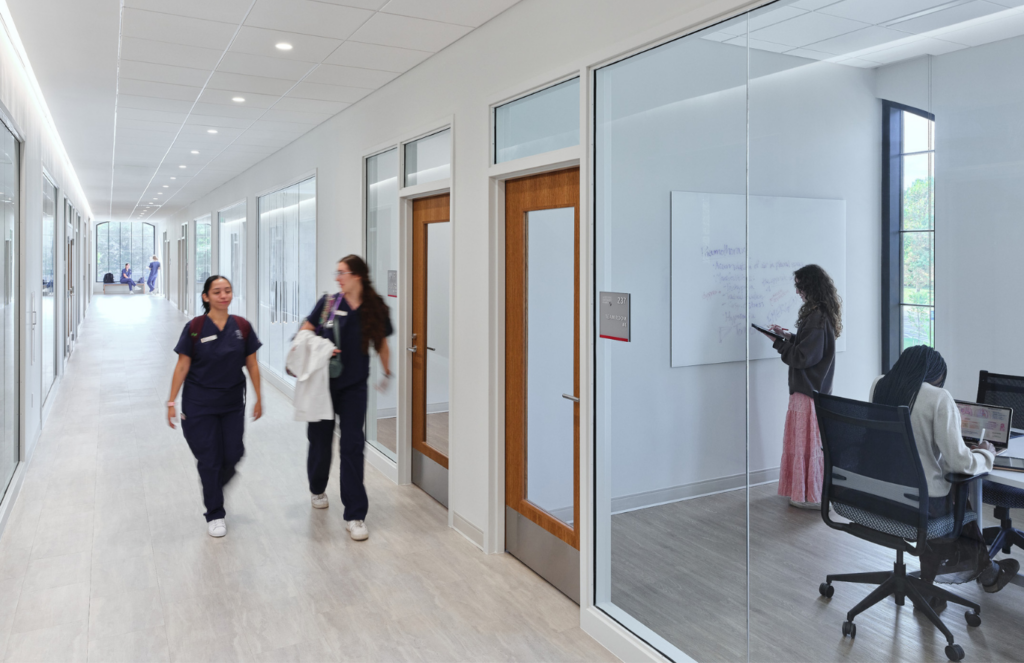
The Conway School of Nursing will not only support the university’s goal of doubling enrollment in the nursing program over the next five to seven years, but it also establishes a new campus gateway for all students and visitors. The stately building replaces a former parking lot with a transformative academic hub that aligns with the university’s historic architecture while introducing advanced learning and sustainability features. Positioned at a prominent and highly visible site on the urban campus, the building was designed to be a new landmark, featuring a tower element that serves as both a visual and a symbolic entryway.
Additionally, the building’s site plan and landscape design by Michael Vergason Landscape Architects and Ayers Saint Gross reinforce a cohesive campus framework. In addition to the tower feature, the exterior is defined by a cascading stair that links an upper-level student commons to the Trinity Fountain below and a north quadrangle framed by the John K. Mullen of Denver Memorial Library, Edward M. Crough Center for Architectural Studies and McCort-Ward Hall.
On the third floor, a terrace shaded by a timber pergola offers sweeping views across campus, including vistas of the Basilica of the National Shrine of the Immaculate Conception to the west.
Collegiate Gothic Design and Contextual Integration
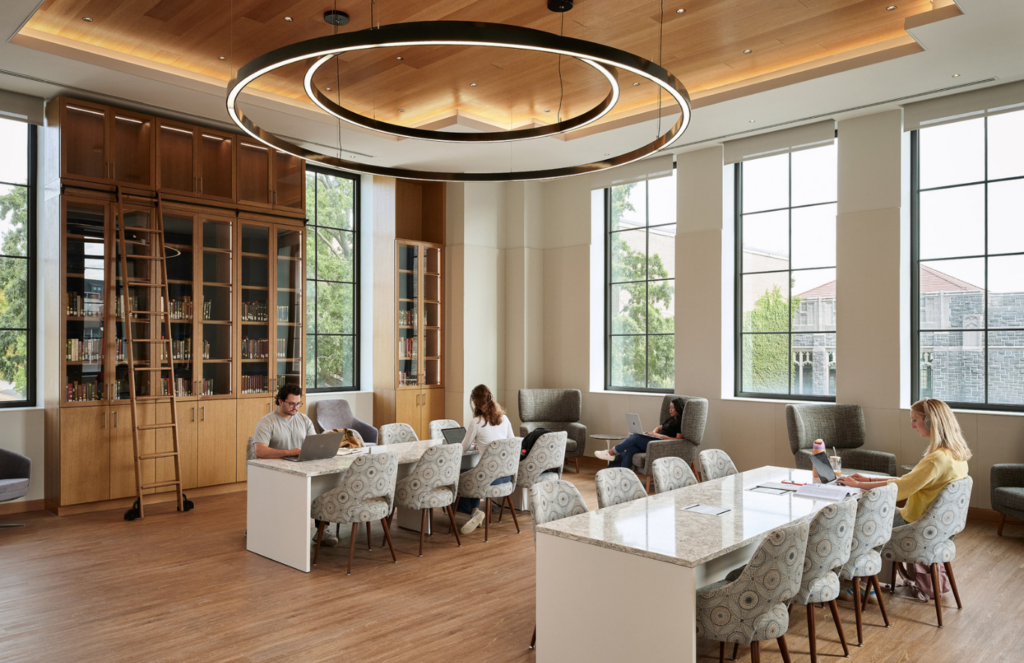
The Conway School of Nursing appropriately matches the scale and massing of neighboring buildings while embracing the Collegiate Gothic style that defines the Catholic University campus. The facility was designed to blend seamlessly with the university’s aesthetic of stone, clay roof tiles and bronze light fixtures.
The building’s facade showcases a creative use of reclaimed granite, which was salvaged from Philadelphia’s Transfiguration of Our Lord Church, built in 1924 and demolished in 2009.
RAMSA developed a cost-effective precast panel system that integrated the salvaged stone into the modern building envelope. Each stone was split to create a flat face and then was adhered to custom precast concrete panels, producing a durable, modular cladding system that preserves the look of traditional hand-laid masonry. This technique transforms the salvaged, century-old masonry into a durable, modular cladding system.
“It was cool to see details that came from the old church — like the holes that were drilled into the stone for flagpoles,” said Tony McConnell, Senior Associate with RAMSA, who led the precast effort. “We chose to keep all those elements, so that as you walk around the building, you see these little follies you wouldn’t expect on a brand-new facility. It feels authentic.”
To achieve an even higher level of authenticity and articulation, RAMSA also incorporated CNC-milled molds and rubber casting to replicate intricate stone patterns.
“Detailing is challenging, but we detail our buildings to the nth degree,” McConnell said. “We want our traditional buildings to look like they’ve been there for 100 years, and they need to fit into the context next to them. Poorly articulated details are a dead giveaway. Historically, precast doesn’t like those details — it wants flat, simple things — but we’re seeing that it can do much more.”
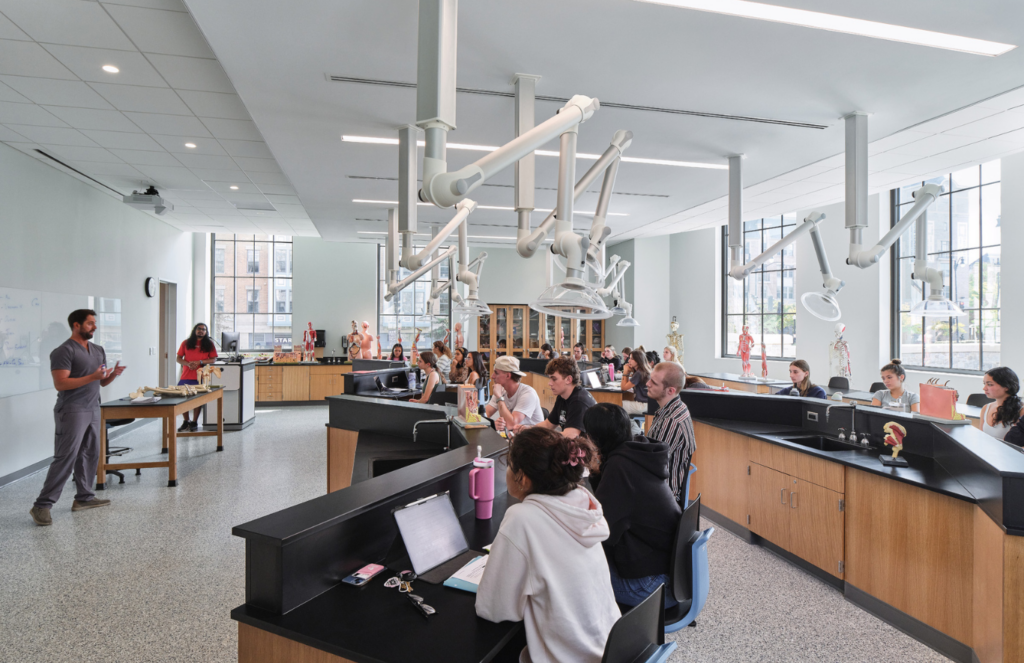
The panels were then finished with traditional mortar, preserving the appearance of hand-laid stonework while benefiting from the efficiency, structural integrity and ease of installation offered by facade panelization. This cost-effective fabrication and installation approach improved weather tightness and energy efficiency.
The precast method had the additional benefit of making the project easier to complete on a tight urban site. As the busy main road in front of the building couldn’t be shut down for any extended period, using precast significantly expedited the construction schedule and improved safety and efficiency.
“With precast, we don’t have people climbing up and down scaffolding,” McConnell added. “Anytime we can reduce scaffolding, job sites are safer places.”
The creative reuse of existing materials also helped the facility achieve LEED Gold certification (it is also targeting WELL Silver), thanks to the incorporation of green roofs, stormwater management systems and bioretention facilities.
Learn more about how the building blends tradition and technology while centering wellness (and fulfilling a vision that was first established in Catholic University’s 2012 campus master plan) in the September/October 2025 edition of School Construction News.
Learn More
Project Name: The Catholic University of America Conway School of Nursing
Area: 102,000 gross square feet
Construction Cost: $62 million
Architects: Ayers Saint Gross in collaboration with RAMSA (Robert A.M. Stern Architects)
Landscape Architect: Michael Vergason Landscape Architects
Structural Engineer: Simpson Gumpertz & Heger
MEP Engineer: Burdette, Koehler, Murphy & Associates
Civil Engineer: Rummel, Klepper & Kahl
Traffic Engineering: VHB
Cost Estimating: Forella Group
AV/IT/Security: Convergent Technologies Design Group
Code Consulting: GHD
General Contractor: Clark Construction Group
Precast Subcontractor: High Concrete Group