

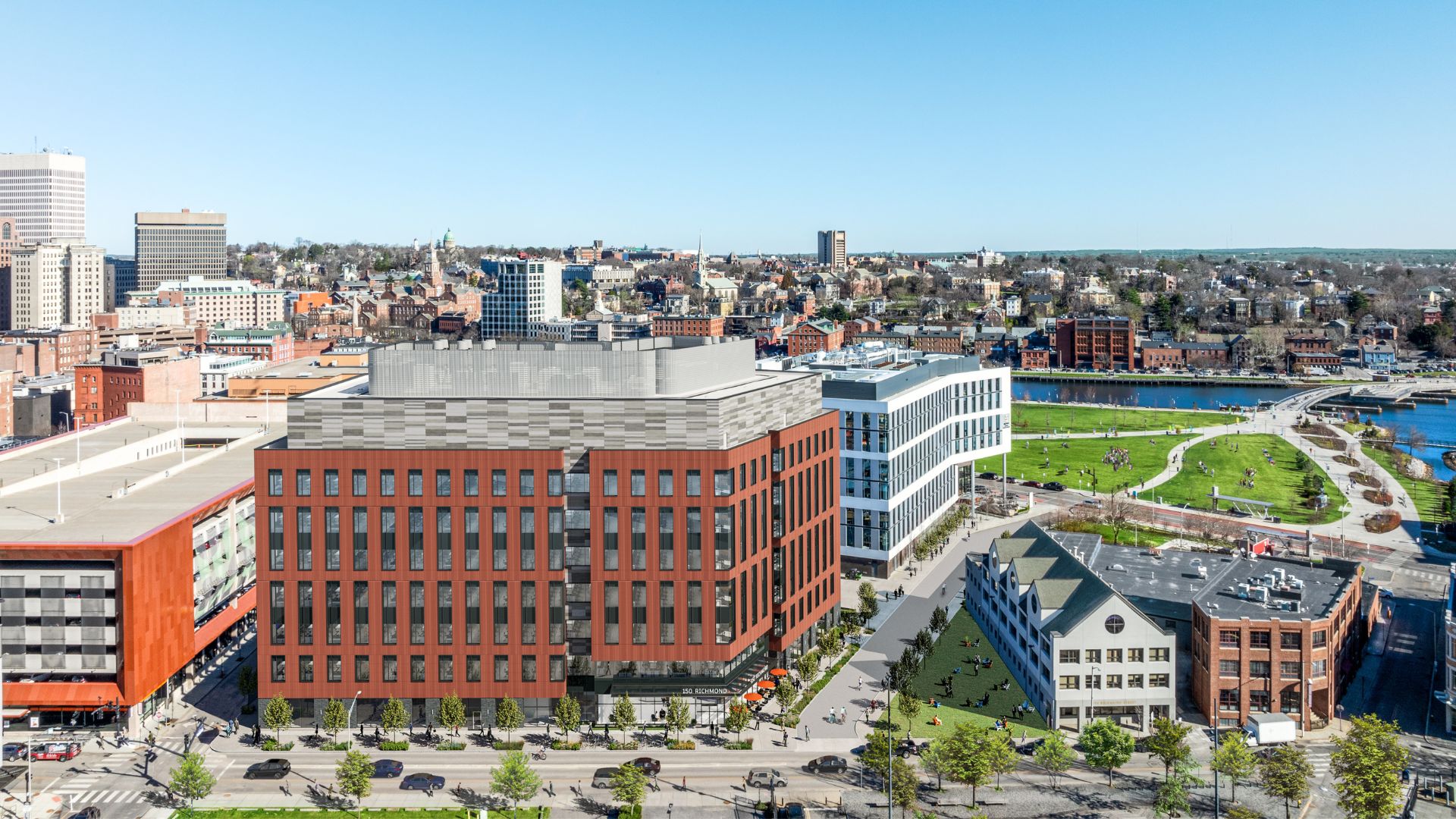
PVD Labs is a purpose-built research and innovation facility developed in partnership with Brown University, the City of Providence, and the State of Rhode Island. Anchored by the State’s Public Health Lab and the Ocean State Labs incubator, the project expands Rhode Island’s life sciences infrastructure and supports commercialization, academic research, and startup growth in the heart of Providence. | Photo Credit: Courtesy of Ancora
By Josh Parker
If you’ve worked with one university, you’ve worked with one university. It’s a simple line, but a reminder of the lesson we’ve learned over the last 25 years — durable relationships matter — because the opportunities on each campus emerge only when you understand the institution behind it. Each institution has its own ecosystem of governance structures, stakeholders, business lines and community relationships. For nearly all traditional commercial real estate players, that complexity feels intimidating. That unique complexity is exactly what makes the higher-education investment landscape one of the most attractive (and misunderstood) asset classes. And when you get the relationships right, the complexity becomes a source of stability — producing outcomes that are better aligned with institutional needs and more resilient for long-term investors.
Higher education is facing a nearly $1 trillion mountain of capital investment needs — much of which is driven by decades of deferred maintenance and the rising cost of modernization— alongside mounting pressure on operating models, enrollment and public funding. Institutions now need access to a permanent, reliable base of private capital that can flex with their evolving mission. A good investment approach starts not with “This is what we build, and we can put one here.” but instead, “What outcome are we trying to achieve, and what risk framework will make that outcome durable for the institution and its stakeholders?”
Relationship-centric in a Shared-governance World
There are no single-voice counterparties in higher education. Shared governance, multiple boards and committees, individual faculty influence, student needs and community expectations all factor into major facilities decisions. Unlike a corporate setting where a CEO and board can greenlight a project relatively quickly, the path to consensus on campus is longer and more iterative. That can be frustrating if you are used to more centralized decision-making. We’ve found it is actually the pathway to more resilient, long-term solutions.
Many of our team members have led operations inside universities and understand how these institutions function. We know the language, the constraints, and the tradeoffs that leaders manage every day. That shapes our posture. We work with campus leaders through the uncertainty of market, regulatory and political conditions to co-design solutions. That process takes more time, but it produces solutions that are better aligned with institutional needs and more stable for capital providers over the long term.
Mission Alignment as an Investment Discipline
For those involved in university construction and campus planning, the question is not only whether capital is available, but whether that capital is structured to advance core educational and community goals. At our firm, “mission alignment” is not a slogan; it is the starting point for underwriting.
On some campuses, the objective is straightforward: deliver the right residential, instructional, research, or student-life environment to support learning and belonging. In other cases, the campus itself is not a focal point. The priority is to catalyze economic development and job creation in the surrounding region. Our work with the University of Notre Dame and partners in South Bend, Ind., falls into this category. The goal is to expand the research enterprise and drive broader economic outcomes in the community, not simply to deliver a project, but to create impact in the region. And in places without deep markets, achieving that impact requires aligning the university’s objectives with those of the city, state, and philanthropy and then designing a financial structure large enough to be catalytic, yet appropriately de-risked for everyone involved.
This mission-first approach also means recognizing that some of the most stressed parts of the university business model — athletics, healthcare, and other ancillary enterprises — need both capital and operational support. Increasingly, our conversations involve the balance sheet and the profit-and-loss statement. We are not just financing real estate; we are helping reengineer business lines, so they no longer require ongoing subsidies from core academic operations and, ideally, contribute back to the teaching and research mission.
From Debt-only to an “Equity Layer” in Higher Ed
Historically, investors who wanted exposure to university credit bought taxable or tax-exempt bonds. Equity-like investment opportunities were rare and usually limited to one-off public-private partnerships where universities shouldered most of the risk to move projects off balance sheet. As institutions have become more sophisticated, they have recognized that those older models often misallocated risk and constrained what was possible.
What is emerging now is an equity layer in university infrastructure, providing structures that offer investors stable, risk-adjusted returns while staying closely aligned with the institution’s long-term objectives. Our role is to help design those structures so that investors receive stable, risk-adjusted returns while universities, public-sector partners, and other stakeholders participate appropriately in de-risking the venture and upside sharing. When done well, this equity layer becomes the connective tissue between mission alignment, financial resilience, and the scale required to achieve meaningful impact.
In a market like South Bend for example, you cannot achieve real transformation through a series of small, tentative projects. You need scale. But scale in a thinner market is, by definition, riskier. By having the university and public entities participate in de-risking the transaction, we can deploy larger amounts of capital at a lower overall risk profile, creating truly catalytic impact matched to the university’s long-term commitment to place.
This shift from a debt-only mindset to a more nuanced capital stack is one of the most important changes ahead for “universities-first” investment strategies. As more operating lines from research commercialization to workforce-focused programming seek capital, the institutions that can partner with permanent capital providers will be better positioned to adapt.
Universities as Enduring Civic Infrastructure
For communities seeking inclusive, sustainable growth, universities bring something few other anchors can: durability. Corporate tenants can be powerful catalysts, but they can also relocate when strategy or leadership changes. By contrast, major universities with strong credit and broad teaching and research mandates are deeply tied to place. Today, it is simply too expensive and impractical to pick up a large, diversified campus and move it somewhere else. Their presence is long term by design.
That long-term presence allows universities to think in decades, not quarters, when it comes to revitalizing surrounding districts. It also allows project sponsors and builders to align investment horizons with a realistic timeline for neighborhood change. You cannot “fix” an urban district with one marquee project. You need repeated investment, programming, and partnership. Universities are uniquely positioned to do that across academic, clinical, cultural, and economic dimensions, which is why designing with, for, and including them, rather than merely near them, is such a powerful strategy.
The institutions that will thrive in this environment are those willing to rethink their business models and invite capital partners into the conversation early, not only when a project needs financing. That shift creates room for more thoughtful risk-sharing, stronger alignment between mission and capital, and a clearer path to long-term resilience. The opportunity in front of all of us is to treat universities not as just another sector in a portfolio, but as enduring civic infrastructure – central to talent development, innovation, and community vitality – and to align private capital with that reality over the long haul.
Josh Parker is the Founder, Chairman, and CEO of Ancora, where he leads the firm’s strategy and oversees all investment and partnership activity.