

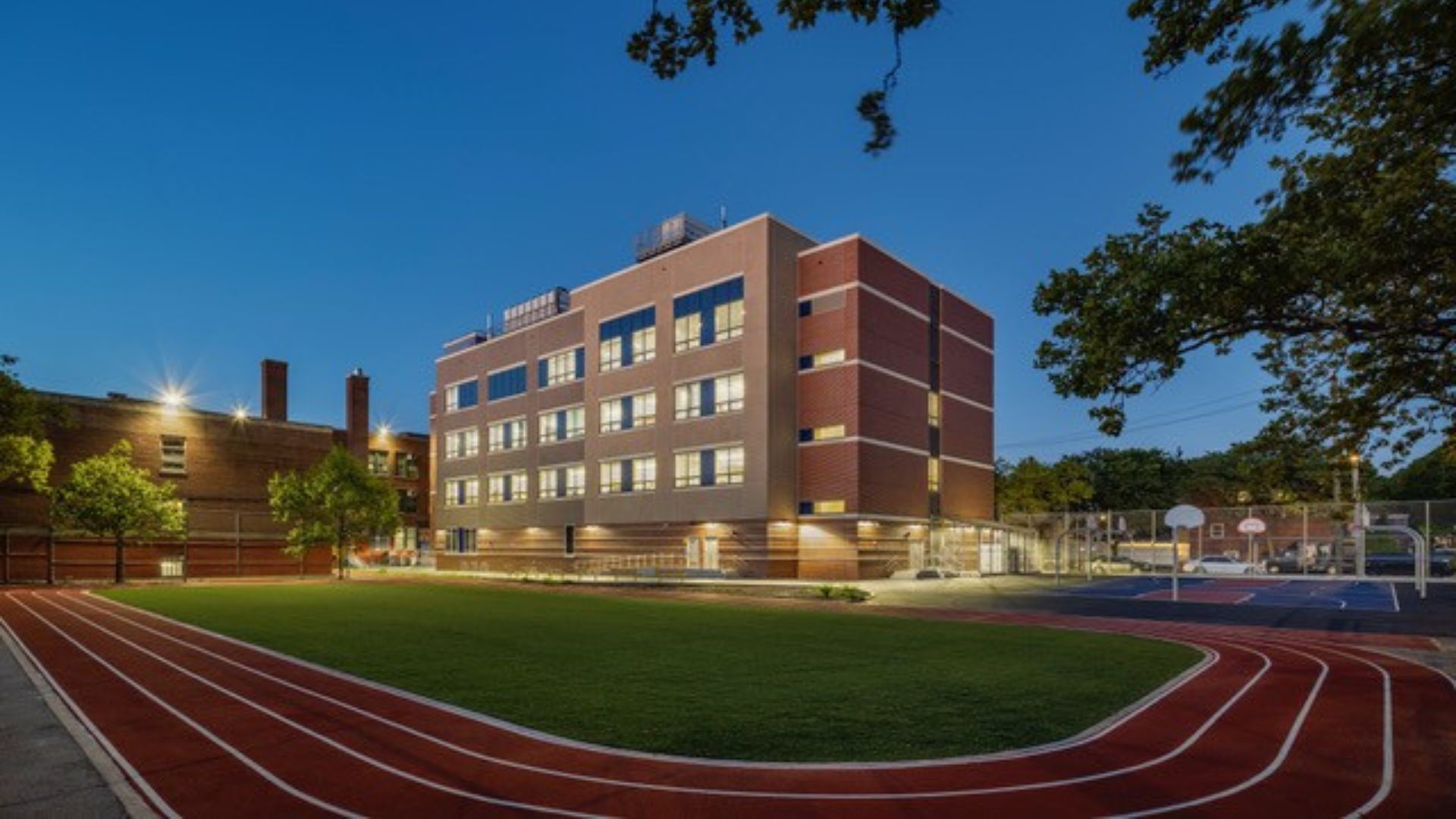
Delivering a major addition on a fully occupied elementary school site in a dense residential neighborhood required precise phasing and operational coordination. | Photo Credit (all): Albert Vecerka/ESTO, courtesy RKTB Architects
By Lindsey Coulter
A 58,000-square-foot expansion at P.S. 87 in the Wakefield section of the Bronx is reshaping both the school’s footprint and its long-term performance. Designed by RKTB Architects for the New York City School Construction Authority (SCA), the project delivers 17 new classrooms for grades preK-5, eight special education classrooms, art and music studios, a guidance suite, and expanded administrative and medical offices.
But the intervention extends well beyond added square footage. The project reframes the campus around universal accessibility, all-electric building systems and a contemporary gymnasium-auditorium, while modernizing circulation and shared spaces within the existing 1930s structure.
“More than an expansion, our work to address P.S. 87 is a modernization effort,” said Albert Aronov, AIA, principal at RKTB and head of the firm’s academic studio. “Now the school is equipped with elevators and new restrooms that can accommodate students, faculty and staff with the widest range of accessibility needs. We also introduced central air conditioning and heating for the addition, as well as a state-of-the-art combined gymnasium-auditorium.”
The result is a unified campus designed to meet contemporary pedagogical, performance and community expectations.
Phasing Construction on an Active Campus
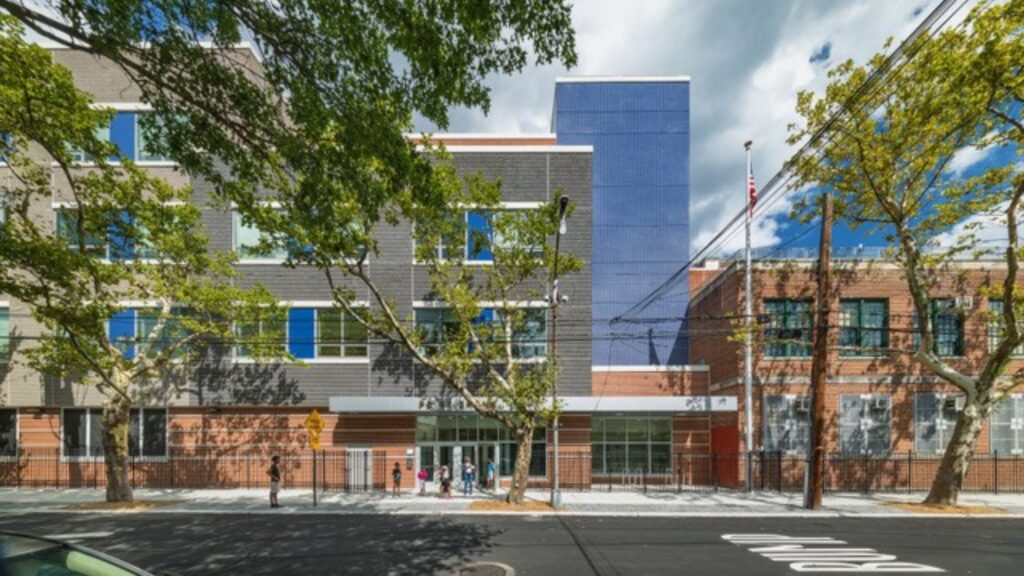
Delivering a major addition on a fully occupied elementary school site in a dense residential neighborhood required precise phasing and operational coordination. Limiting disruption to instructional time — while maintaining life-safety and code compliance — was a central priority.
“The biggest challenge was to complete the construction within the shortest possible timeline, in order to limit the disruptions to the work of teachers and students and any inconvenience to neighbors in this primarily residential neighborhood of Bronx, NY,” Aronov said. “We worked closely with the New York City School Construction Authority on a solution that combines a steel frame with concrete insulated panels. This approach is atypical for SCA, but they recognized its value not only because it shortened the construction timeline significantly but also because of the resulting high-performing building envelope with superior thermal performance, efficiency, and durability.”
RKTB coordinated closely with SCA’s construction management team, school leadership and the Department of School Facilities to map daily circulation patterns and identify sensitive zones.
“Working on an active, fully occupied school facility with a goal of uninterrupted operations requires an approach centered on safety, continuity, and careful planning,” Aronov said. “When existing exits or corridors had to be temporarily closed, the design team prepared temporary egress plans that maintain full code compliance and ensure safe, intuitive movement throughout the school during each construction phase.”
The strategy allowed the campus to function continuously while major structural and systems work proceeded.
A Contemporary System Within a Neighborhood Context
While the structural system and envelope represent a contemporary departure from typical SCA practice, the addition was carefully calibrated to harmonize with the surrounding low-rise houses and apartment buildings.
“School buildings are the heart of the communities they serve, often used not only for instruction but for other community uses as well, so the aesthetics and interplay with neighboring properties matters a lot,” Aronov said. “To harmonize with the architectural context of houses and low-rise apartment buildings, the design solution applies a varied façade of blue, dark grey, and traditional clay red brick veneer, with setbacks to break up the massing and modulate the building profile.”
Brick veneer integrated into precast insulated panels creates visual continuity while enhancing envelope performance. Continuous floor levels connect the addition and original building, reinforcing a seamless interior experience for students and staff.
Site improvements further extend the school’s community presence. A rebuilt schoolyard includes a turf field and running track, basketball court, early childhood playground and public sitting area. A metal canopy and flagpole mark the new main entrance at street level.
Universal Accessibility as a Design Framework
The modernization addressed accessibility comprehensively, extending improvements beyond code minimums.
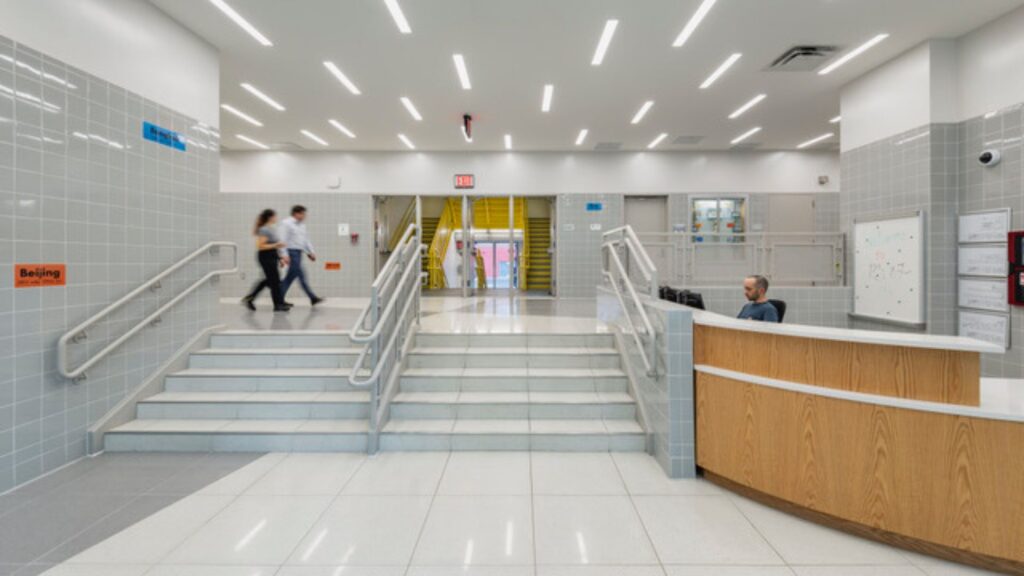
“Opportunities to improve accessibility were identified both in the addition and in the existing building, which dates back to the 1930s, long before accessible was a design consideration,” Aronov said. “First, the fully accessible street-level entrance to the expansion became the new main entrance to the entire school. Then our design ensures that the addition and existing building are connected seamlessly on every floor, creating a unified interior that anyone can access using the new elevator on the expansion side.”
New fully accessible boys, girls and unisex restrooms were inserted on every floor at the junction of the new and existing structures. Specialized classrooms created from former office space were designed for full accessibility, and drinking fountains and other legacy elements were upgraded.
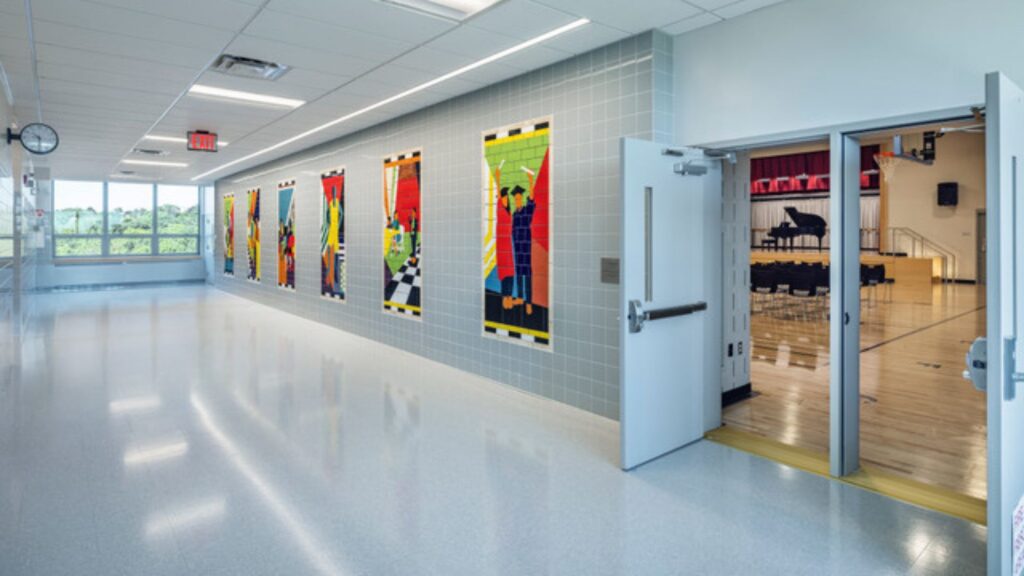
The gymnasium-auditorium and cafeteria — supported by a state-of-the-art commercial kitchen — were also designed as inclusive, shared environments capable of supporting assemblies, performances and community events.
Performance Standards and All-Electric Operations
Performance goals were shaped by SCA’s Green Schools Guide, a framework widely regarded as comparable in rigor to LEED for Schools. The concrete insulated panel façade, brick veneer and high-efficiency glazing contribute to a high-performing building envelope optimized for durability and thermal efficiency.
“SCA’s requirements for energy-efficiency and environmental sustainability are among the most stringent of any school district in the country,” Aronov said. “Designed and built for all-electric operation, eliminating the need for increased fossil fuel use, the addition features a dedicated central heating and cooling system. Overall, the design ensures operations and energy costs are as low as possible.”
The all-electric strategy positions the school to adapt to future decarbonization goals while providing consistent thermal comfort.
Maximizing Space on Constrained Urban Sites
Urban campuses in New York City offer little margin for horizontal expansion, placing a premium on circulation efficiency and program stacking.
“In New York City, space is always at a premium,” Aronov said. “For school additions, which are generally between 50,000 and 60,000 square feet in size, we consider the floor plans very carefully to ensure efficient circulation for foot traffic as well as safe and efficient operations overall.”
The P.S. 87 project builds on RKTB’s prior work at P.S. 19 in the Bronx and informs ongoing efforts at P.S. 116 in Queens, where sustainability features such as rooftop solar panels and a vegetated green roof are planned.
At P.S. 87, the combination of expanded capacity, enhanced accessibility and improved performance demonstrates how targeted additions can extend the life and relevance of legacy school buildings — without compromising daily operations or community identity.
Project Info
- Architect: RKTB Architects
- Client + CM: New York City School Construction Authority
- GC: TECHNICO
- MEP: Shenoy Engineering
- SE: Thornton Thomasetti
- Civil: Leonard J Strandberg & Associates
- Environmental: STV Inc.