

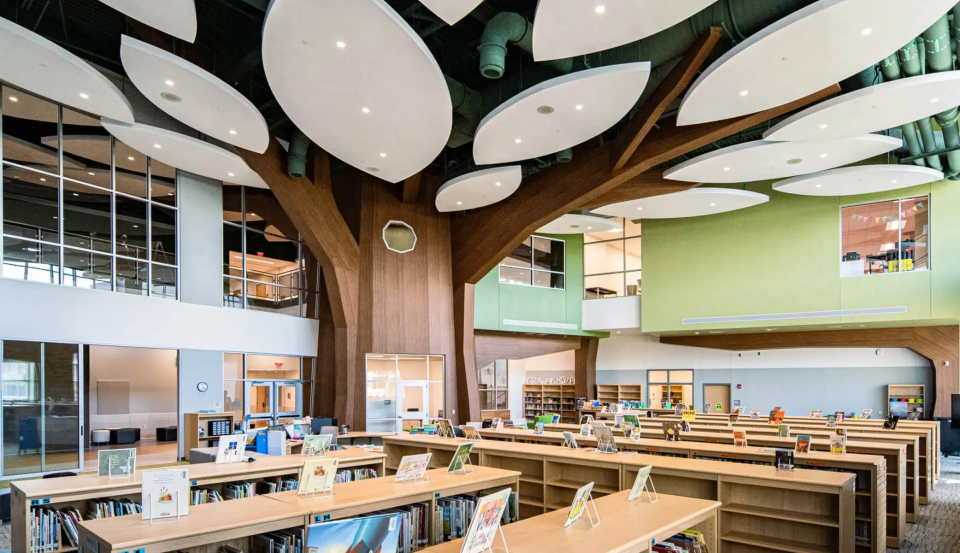
Caption: HPM has worked with Round Rock ISD for more than nine years and is currently serving as the program manager for the district’s $500-plus million capital bond program.
By Tracy Richter
One of the most pressing challenges in the world of K-12 education is aging school facilities and infrastructure. Despite an average of over $18 billion annually spent on K-12 school construction over the past 15 years, the average age of main instructional facilities is approaching 50 years nationally and fewer than half of these facilities have undergone significant renovations or replacement since their original construction. Since 2010, a majority of the funding has been directed toward new construction, with budgets prioritizing new facilities over maintaining existing ones, leading to a growing funding gap for necessary repairs.
Contrary to traditional thought, the approach to comprehensive facilities planning is often not an architectural solution, but a much deeper dive into what drives the need for improved facilities and infrastructure. This is reinforced by the fact that a majority of K-12 districts prioritize facilities planning only when they are anticipating a request for funding from their communities. However, facilities planning may be more critical when funding is at risk. Outdated, often dilapidated buildings combined with rapidly changing demographic factors and the evolution of educational pedagogy make it increasingly difficult for school districts to meet the needs of the modern student population.
Starting With the “Why?”: Focus on Your Educational Mission
Improving existing infrastructure begins with understanding the desired intent of the school facility, both today and in the future. It is imperative to modernize existing facilities and keep them rooted in the core of education, while creating an experience instead of just a space.
A strategy that planners can emphasize to district leadership is programmatic attraction. Districts should evaluate the programming and amenities available to students at each school. These can include STEM, performing arts, athletics, foreign language immersion, career readiness/workforce development and early college programs. By improving the programmatic offerings, which cater to the user experience and adequately prepare students for college and life after graduation, districts can better attract students to formerly under-enrolled schools. Increasing attendance at these types of schools is often achieved through programmatic choice pathways. Coupling this with demographic analysis such as a live/attend study, which indicates where students live versus where they attend school, can provide valuable insight into why students choose different schools outside their boundaries.
Understanding the “Gap”: How Do Districts Get Where They Want to Be?
A comprehensive diagnosis of a district’s facilities is a critical step to understanding the “gap” between where you are today and where you aspire your facilities to be. Facility assessments should contain two major components: a physical assessment of the component and system condition that make up the bones of the facility, and an educational adequacy assessment that is measured against educational standards of today and in the future. The K-12 planning process begins with an Educational Adequacy Assessment, during which faculty groups identify the essential components for effective learning spaces. A facility walk-through evaluates the presence of these components. Following this, a Facility Condition Assessment is conducted to analyze building conditions and maintenance costs, highlighting the importance of performing the Educational Adequacy Assessment first to avoid cost increases. After all the assessments have been completed, a State of Schools Report is created, providing stakeholders with a comprehensive overview of data including enrollment, utilization and demographics, in easy-to-understand graphs.
Based on the assessments, planning services professionals develop solutions, such as renovations or new additions, to meet the district’s needs. These options are then presented to the district administration. Then, community meetings are held to gather feedback through surveys. Community input is crucial for refining recommendations and addressing stakeholder concerns. Finally, a 10-year facilities management plan is developed, which outlines service needs, timelines and costs. This plan will guide the district’s current and future initiatives.
Who Are You Serving?: How Demographic Shifts Affect Infrastructure Decisions
Demographics are ever-changing, leading to uncertainty among district leadership about how to address aging facilities appropriately. Factors such as declining birth rates, homes not regenerating school-age students and a lack of affordable housing have all led to uncertainty when projecting how many students a district will serve in the future.
According to CDC data, the U.S. birth rate has been steadily declining, with a 2% annual drop since before the COVID crisis. Birth rates are now highest among women aged 30–34 — a shift from 2005, when the peak was 25–29 — while teenage pregnancies have fallen sharply. Together, these trends will continue to impact district enrollment in the years ahead.
The housing market has also played a large role in enrollment shifts. The rapid increase in housing costs has meant that the typical empty nester who would choose to downsize to a smaller footprint is not as frequent as it once was. Going to half the house for twice the money and three times the interest rate is not a desirable goal for most.
In many cities across the country, the gentrification of housing driven by the goal of progress and improvement has become the norm. However, the increase in housing costs in urban communities and large metro areas continues to be felt by school-aged families who can no longer afford to live in these areas. This has led to an increase in transience among school-aged families, making them less likely to settle in one district throughout their children’s years in K-12.
Read the full article, including insights on how planning services canhelp school districts with aging facilities, in the Planning & Construction issue of School Construction News.