
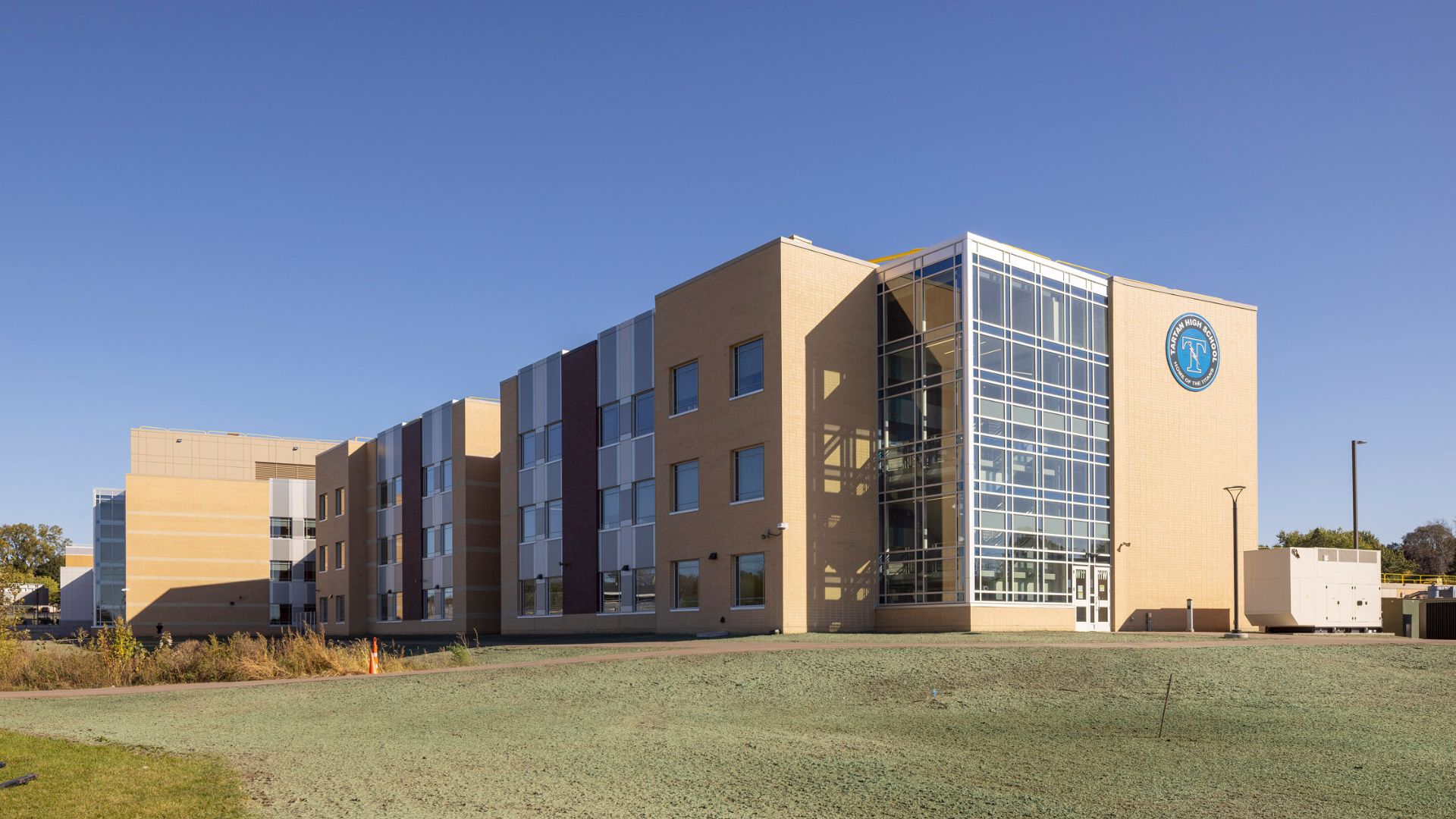
Rather than replacing the school, the district pursued an addition and renovation strategy that kept the campus operating on its existing site, reducing both cost and waste. | Photo Credit: Courtesy of Wold Architects & Engineers
By Sal Bagley
The recently completed transformation of Tartan High School in Oakdale, Minn., shows how districts can modernize an aging campus while meeting expectations for flexibility, student well-being and equity.
Rather than replacing the school, the district pursued an addition and renovation strategy that kept the campus operating on its existing site, reducing both cost and waste. Voters approved the work in spring 2019 as part of a districtwide effort that also included another local high school and set shared goals for both projects: strengthen safety and security, increase capacity at each high school to 1,800 students and create more flexible teaching and learning spaces. While the two buildings presented different constraints, the designers, Wold Architects and Engineers (Wold), were tasked with creating an equitable student experience, regardless of which high school students attend.
“Modernization can support equity when districts are clear about the experience they want every student to have,” said Wold Education Practice Leader Sal Bagley. “It’s about more than updating finishes. It’s about removing barriers and creating additional opportunities for connection.”
The Challenge: An outdated layout
Originally designed in 1969, Tartan featured two classroom “circles” of wedge-shaped rooms organized around central circular corridors. Interviews with students and staff surfaced operational issues familiar to many districts. Wayfinding was unclear. Major gathering spaces, such as the cafeteria, were constrained in single-story volumes. Classrooms were undersized and served by narrow corridors, contributing to congestion during passing times.
The building also struggled to meet current expectations for well-being. Daylight was limited to narrow slot windows, and many learning spaces were fully interior with no access to natural light. Low structural heights resulted in limited options for modernizing HVAC systems. The cafeteria lacked enough seating, pushing some students to eat in their cars. Student resources were scattered throughout the building, adding friction for students trying to access support within a busy school day.
These conditions are common in legacy schools: the building functions, but it does not support how the school currently needs to operate. Frequent priorities center around reducing congestion, improving clarity and creating healthier, more welcoming spaces.
Design that Focused on the Student Experience

From the start, the project incorporated student and staff input to shape choices that affected daily routines. They provided months of feedback, including surveys on lockers, a departmental versus interdepartmental model and thoughts on restroom design. That input helped the team focus on comfort, openness and security in ways users would notice.
“For a renovation to make a lasting impact, it has to show up in the moments students feel most. That means enhancing the experience when they’re arriving at school, passing time, eating lunch and seeking support,” Bagley said.
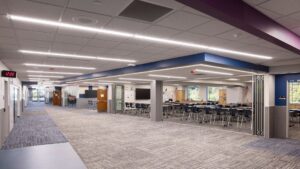
A defining aspect at Tartan was a centralized, daylight-filled commons designed to improve dining and gathering. The existing gymnasium, located at the center of the plan, was renovated into the student commons by adding floors and increasing access to natural light. Smaller spaces branch off the commons to support student groups and activities or clubs.
Academic spaces were also upgraded to adapt as programs evolve. New classrooms were constructed to the north of the building and organized in a departmental model, with flexible options to combine rooms for different group sizes. After the school moved into these new areas, the existing classroom “circles” could be replaced with a clear main entrance aligned with the district’s safety and security standards. Additionally, modern activities and athletic spaces were added to support practice and competition needs for students and spectators’ experiences.
Planning for Performance and Continuity
Modernization should support reliable operations for decades. At Tartan, infrastructure was aging and maintenance costs were rising. Systems from the heating plant to air distribution, roofing and electrical distribution were updated or replaced to extend the life of renovated areas and improve occupant comfort.
At the same time, the district faced a challenge many communities share – it needed to renovate without closing the school. Tartan remained open through a 14-phase plan from spring 2022 through summer 2025, with new areas coming online as other sections were updated or demolished. Students and staff relocated at times, making regular communication critical to managing disruption.
“Phasing goes beyond a construction schedule to plan operations, “ Bagley said. “It was important that students didn’t miss out on learning because of disruptions.”
What Other Districts Can Learn
Tartan’s experience offers practical lessons for other districts. Projects should start by defining the student experience you want to improve, then use student and staff input to confirm what is not working and what matters most. Prioritize changes that reduce daily friction, such as clearer circulation or shared spaces that support connection and more consistent access to daylight. Build flexibility into academic planning so spaces can adapt as teaching models and enrollment change. In an older building, that may mean targeted new construction paired with selective demolition and replacement of the most limiting parts of the plan.
Treat infrastructure upgrades as essential, not optional. A school cannot deliver on comfort and well-being if the systems that heat, cool and power it are unreliable or outdated. Finally, if the school must stay open, plan phasing around instruction and communicate it consistently. Predictable updates and clear expectations can reduce stress for students and staff while building trust with families.
Modernization as a Tool, Not a Compromise
In early 2026, Tartan received the top award from the Minnesota Construction Association for addition and renovation projects, recognized for its project’s complexity and success. More important than the recognition is what the project demonstrates for districts facing similar conditions: addition and renovation can be a strategic alternative to full replacement when the goal is to modernize a campus, improve the student experience and extend the life of a building.
Tartan’s transformation shows that reinvesting in a legacy facility can move beyond patchwork improvements. With clear experience goals, flexible learning spaces, upgraded infrastructure and disciplined phasing, districts can deliver a modern school environment while keeping students learning on site.
Sal Bagley is an Education Practice Leader for Wold Architects & Engineers.