
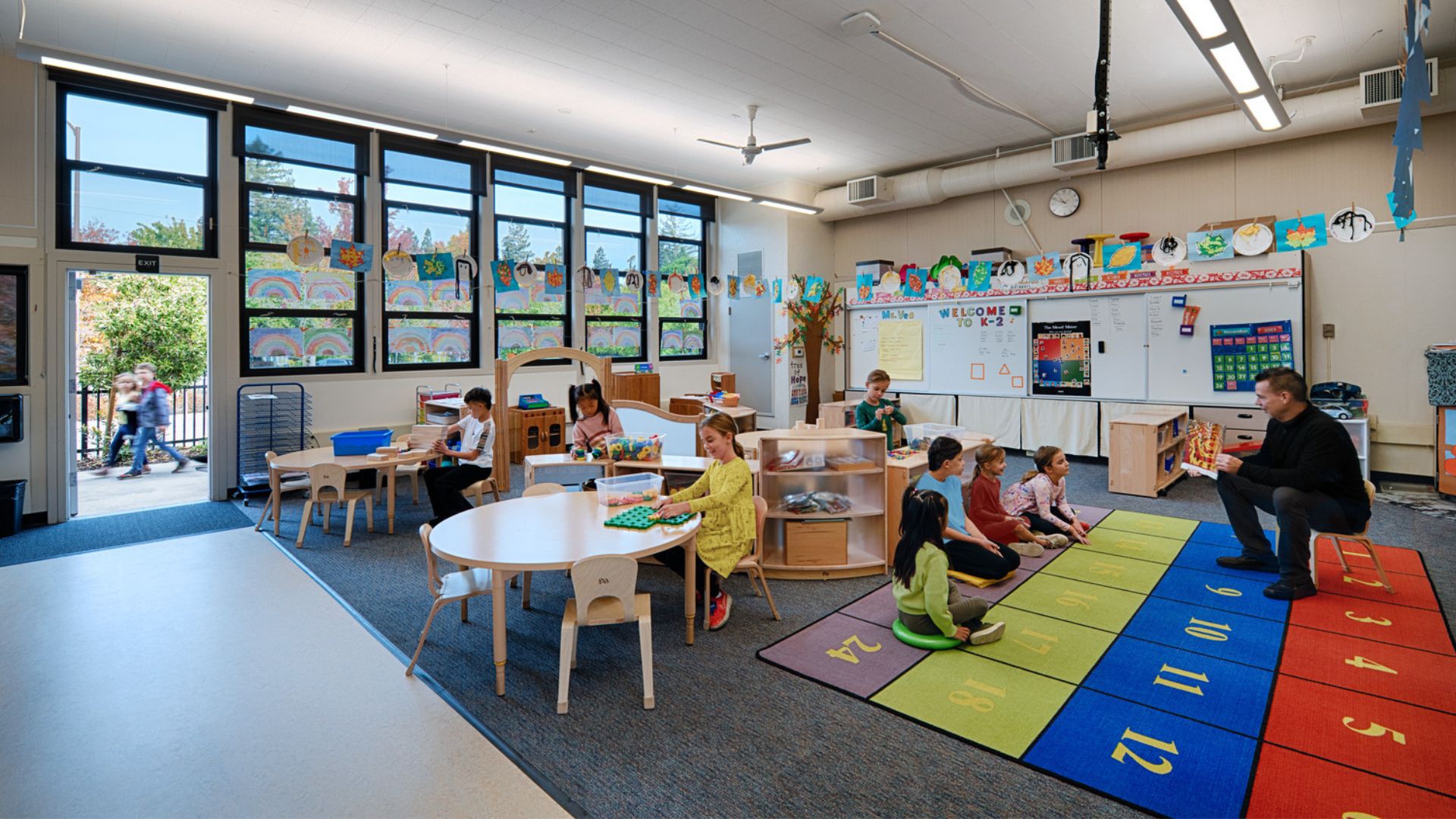
Features such as garage doors or large windows are used to maintain clear visual supervision between indoor and outdoor learning areas. | Photo Credit: Courtesy of HED
By Jennette La Quire, AIA, LEED AP ID+C
Across all grade levels, hands-on learning is gaining renewed momentum. As teachers and administrators increasingly embrace experiential approaches, education is transforming into a more active, collaborative and dynamic process for students. This shift is fueling a demand to creatively and effectively connect theoretical knowledge and practical application — and is set to define 2026 and beyond.
Nurturing Wellbeing with (and without) Technology
Safety is the priority for all school design stakeholders. Creating a single point-of-entry, while allowing for emergency egress from various parts of the campus, is a strategic way to enhance security without installing overbearing fencing. Windows enable passive supervision and enhance the overall atmosphere. While light and healthy learning spaces are ideal, they must also be designed with potential threats in mind. Aside from window treatments, interior locks, places to duck-and-cover, and screening via shrubbery, schools are starting to install call buttons (also known as panic buttons), which can instantly alert the entire campus to an emergency. This style of broadcast system is an additional tool to make students feel safe without making them feel confined.
High-resolution security cameras are becoming increasingly common, and not just on the exterior. High schools are experiencing an uptick of students vaping in bathrooms, setting off smoke detectors, and flushing vapes down the toilet, often leading to plumbing issues. One trending solution involves placing a high-resolution camera at the bathroom’s exterior entrance as a deterrent, since they’ll be seen entering or exiting the restroom where these incidents occur.
Adapting to Pre-K (or TK) Inclusion
At the elementary level, school districts are following funding and policy shifts to incorporate transitional kindergarten (TK), also known as pre-K, into both new and existing buildings. The challenge for planners and designers is that state policies often require preschools to meet lower teacher-to-student ratios than the rest of the school, along with in-class restrooms that are easy to supervise.
In HED’s various TK integration projects across the San Francisco Bay Area, cost-effective use of existing infrastructure has been central to successful modernization efforts. For new construction, districts that have not yet received funding or mandates are proactively planning for future TK integration by including stubbing in plumbing and allocating additional classroom space.
Fine-Tuning Food Service
For school districts in California (and elsewhere), the free-lunch policy instituted during the COVID-19 era has continued. As a result, the number of students taking advantage of accessible food has ballooned. To adapt to the increased strain on the cafeteria space and staff, food service is shifting away from long queues of counter service to “speed lines.” At Palo Alto’s Gunn High School, HED instituted lines that move along both sides of grab-and-go, center islands. Minimal staff members are required to scan items at the end of the two lines, ensuring each student receives a well-rounded meal and the food service director can track the volume of items consumed. The trend to streamline food service helps minimize queues, allowing more time for children to eat, and measures the impact on kitchen capacity.
Reimagining CTE
Career Technical Education (CTE) spaces have become drivers for design innovation. Gone are the days of tucking woodshop or auto mechanics in a back room. Practical, hands-on learning environments are taking center stage alongside technology, math, science and art instruction.
In some cases, schools are proactively linking the contemplative and kinetic aspects of CTE, facilitating connectivity through all aspects of a particular career pathway. HED’s project at Santana High School in San Diego County, Calif., involved converting a formerly HVAC equipment-filled mezzanine into a viewing corridor linking the computer lab to the fabrication lab. Given this easy connection, students can work on architectural and engineering project calculations and drawings; then, they can easily move to the neighboring auto shop, fabrication lab, or electronics lab to bring their creation to life. Incorporating both the technical and hands-on aspects of that learning experience helps students get a feel for different careers, such as engineering versus construction, and gain insight into potential pathways after graduation.
Embracing the “if you can see it, you can be it” philosophy, the Grossmont Union High School District integrated a health occupation center into its campus. The facility delivers professional training and certifications for in-demand careers, such as dental assistant, vet tech, phlebotomist, EMT and nursing assistant. For younger students, it creates a sense of access and possibility.
Read more about CTE spaces, and how adaptable spaces and new technologies can also support flexibility and sustainability, in the November/December Technology edition of School Construction News.
Jennette La Quire, AIA, LEED AP ID+C, is the Pre-K-12 Sector Leader at HED and a member of the School Construction News Editorial Advisory Board.