
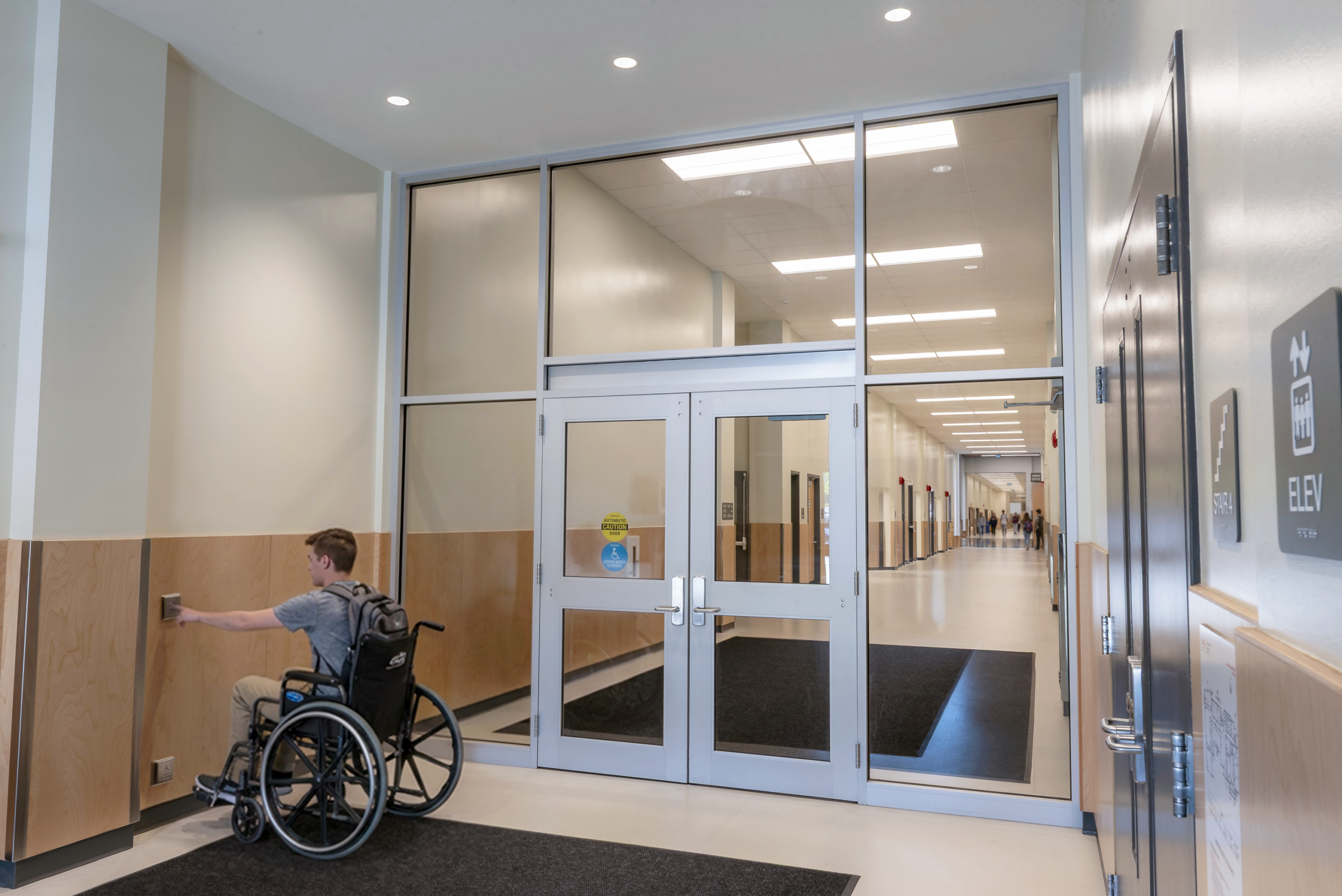
Vital for fire and life safety, cross-corridor fire doors can support enhanced security when specified mindfully. | Photo Credit (all): Courtesy of Technical Glass Products
By Devin Bowman
Learning outcomes often improve when students engage with topics in multiple ways — written responses, discussions, a skills test and so forth. Each path works independently and collectively to support learners.
Similarly, safer school design layers multiple security measures to improve its overall efficacy. Recommended by the Partner Alliance for Safer Schools (PASS), a multidisciplinary organization that develops leading practices for school safety, layered security measures help defend against threats from multiple points on the property. For instance, well-maintained fences can deter and delay external threats. In conjunction, code-compliant corridor and classroom doors can help protect occupants from threats within the building.
In fact, due to their ubiquity, doors are “one of the most heavily used and critically important” aspects of a layered approach to safer school design, according to PASS. This builds on the Sandy Hook Commission Report that states an active shooter has never breached a locked door. Creating multiple, evidence-backed stops throughout the built environment can be an extremely effective security strategy.
But the design and use of these barriers can be nuanced. The following offers an introduction to enhancing school security with code-compliant interior doors.
The Role of Interior Doors in Safer School Design
The PASS white paper, “Doors as Life-Safety Systems,” describes interior doors as “the final physical barrier between safety and harm.” They are key elements in creating effective shelter-in-place locations.
As another PASS white paper notes, fire doors can also serve as barriers between occupants and violent threats, provided these opening systems are designed appropriately, which includes satisfying code-driven requirements for fire and life safety. Cross-corridor fire doors can include closing and locking mechanisms that can be activated during a security breach “to limit an assailant’s movement,” according to the Sandy Hook Commission Report. Many other doors that contribute to compartmentation strategies can buy time for faculty and students to engage in lockdown protocols and for first responders to arrive.
Closing and locking hardware play a significant role in the ability of these doors to satisfy both code-driven requirements and best practices for enhanced security. But they are not the only considerations.
Fire-rated corridor and compartmentation doors can, and often do, include vision panels, sidelights and transoms. These glazing components provide open sightlines for visual connection and more robust monitoring, minimizing areas where students can be isolated. However, glazing components can be seen as weak points if not properly specified.
How to Combine Security- and Fire-Rated Components
Whether an interior fire door incorporates small lites of fire-rated glass, is a full-lite fire door with large glazing sidelites and transoms or lands somewhere between, all the glazing components, like the rest of the door, will need to achieve a fire rating that meets the baseline requirements for fire doors. These ratings can vary between 20 and 90 minutes, depending on project specifics.
When these doors are also intended to contribute to enhanced school security, it is crucial that the entire system is designed so one form of protection is not compromised for the other.
Many security-rated glazing components, including aftermarket films, are plastic-based and can burn quickly and intensely. If they were to ignite, they may reduce the capacity for fire-rated components to protect occupants.
To sideline this concern, project teams can look to multifunctional, fire-rated doors that either incorporate compatible parts or are tested as a system to both fire rating and security rating standards. Doing so will help ensure that doors “function consistently in all scenarios — not just one,” to quote PASS.
A Proven Solution at an Oregon Elementary School
An Oregon elementary school offers key insights into the use of multifunctional, fire-rated glazing in safer school design. A secure entry vestibule was one of several components of the school’s comprehensive safer school design strategy.
Like cross-corridor and classroom doors intended for enhanced security, the openings to this secure entry vestibule balance multiple performance capabilities. By incorporating full-lite glass doors and wall panels, the vestibule allows front desk staff to visually assess visitors and monitor the main hallway for interior threats, both of which contribute to a safer school environment.
These glazing assemblies do more than improve visibility. They maintain code compliance with fire-resistance ratings according to UL Solutions and ASTM International standards. They also offer resistance to forced-entry attack, providing a crucial time barrier between violent threats and occupants within the school. Because these systems use compatible components, the doors and wall panels offer defense against multiple emergency scenarios simultaneously.
The glazing within this secure entry vestibule supports several facets of safer school design without compromising code-driven requirements for fire and life safety — both central concerns to enhanced security best practices.
Key Takeaway: Doors are Complete Systems
When looking at how doors support enhanced security, it is important that project stakeholders understand doors are more than a slab of wood or metal. They are complex systems that include frames, closers, latching mechanisms, hinges, glazing, locking hardware and much more. For fire doors, modifying any single part can create unintended risks and may void fire ratings.
Evaluating and enhancing doors holistically helps ensure they can perform as intended during multiple emergency situations. This holistic approach often benefits from collaboration between designers, end users and proven manufacturers.
Devin Bowman is General Manager of Technical Glass Products (TGP) and AD Systems.
This article was originally published in the 2026 Safety & Technology edition of School Construction News.