
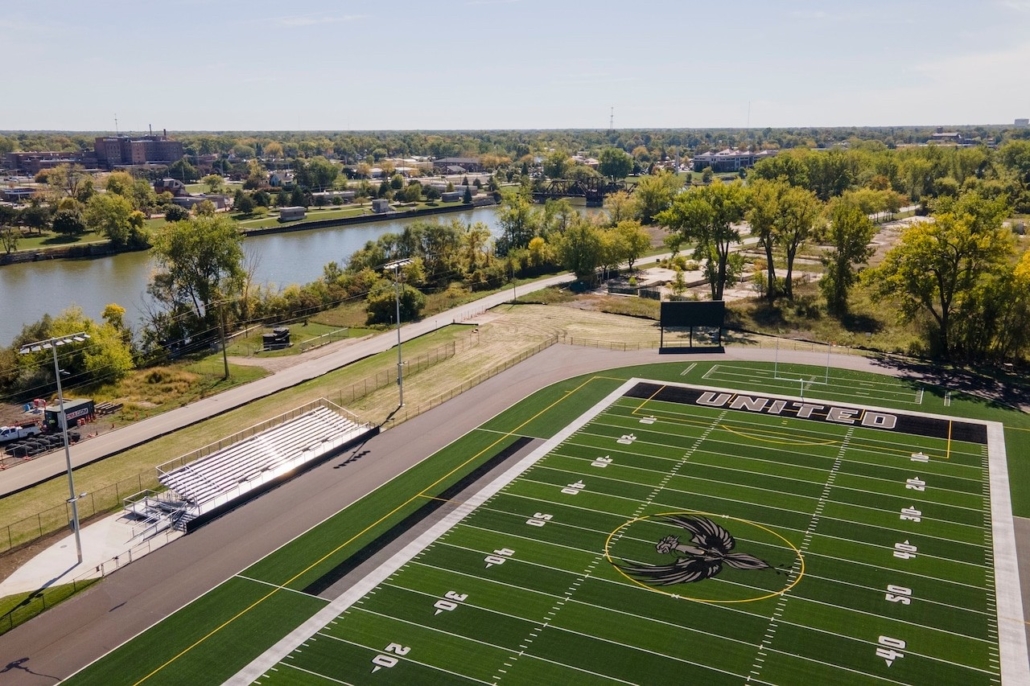
Ameresco partnered with Saginaw Public Schools to upgrade district-wide LED lighting. | Photo Credit (all): Courtesy of Ameresco
By Louis Maltezos
American public schools need an estimated $1.1 trillion in infrastructure upgrades to return buildings to safe, working condition — a backlog built up over years of underfunding. The underlying issue stems from the age of these facilities, with more than half of school buildings constructed prior to 1990. When deferred maintenance builds up, old infrastructure can impact budgets that could be better allocated towards curriculum development, staffing and student programs. The right strategy and financing can aid districts in upgrading essential systems, addressing maintenance backlogs and enhancing learning environments, often without significant initial expenses.
Why School Districts are Upgrading Now
Aging infrastructure is not limited to any one system. Across school districts, it spans heating and cooling, lighting, building controls and electrical systems. Much of this equipment is as old as the buildings themselves and long past the point they were built to last. As that equipment nears the end of life, it takes extra labor and frequent repairs to keep running. What has changed is the ability to treat these upgrades as one coordinated project instead of a series of isolated repairs. Combining measures like high-efficiency heating, LED lighting and modern controls into a single project strengthens both the budget and the learning environment, which is what makes the investment hold up.
School districts depend mainly on local tax measures and bonds for capital. In a small community, the tax base is limited, and bond votes are not certain. The right financing is what allows these upgrades to happen now. Energy savings performance contracts (ESPCs) enable a district to modernize outdated equipment and pay for it with the savings the new systems generate. This reduces both operating and maintenance expenses while enhancing the environment for students and teachers, all without the need for new tax income or capital that a small district may never obtain.
The Charlo School District in Montana exemplifies what can be achieved when districts coordinate their upgrade efforts instead of addressing repairs individually. By replacing aging fuel oil and propane heating with high-efficiency heat pumps, the school is now projected to save more than $93,000 a year in contracted energy savings.
Charlo School District: A Case Study

While the Charlo School District in Montana maintains its schools throughout harsh winters, much of its heating and building infrastructure had deteriorated to the point where replacement was necessary. The district opted to modernize its facilities in two stages.
In the initial phase, the district concentrated on the elementary and high schools, where outdated equipment had far exceeded its lifespan. Efficient heat pumps, upgraded classroom and office HVAC, LED lighting, better gym air circulation and added insulation replaced those failing systems, decreasing energy consumption and enhancing indoor environments. For both students and staff, this translates to more consistent temperatures, improved air quality and facilities that retain warmth during a Montana winter, all while the district reduces its annual costs on energy and maintenance.
Phase 2 reached the junior high and additional learning spaces, where classrooms once heated by aging fuel-oil and propane systems now hold steady, comfortable temperatures throughout Montana’s winters. The buildings run only when and where they are needed rather than around the clock, which lowers energy use and keeps indoor air cleaner for students and staff. Because heat pumps only deliver in a cold climate when a building holds its heat, the district sealed and insulated first, then sized the new systems to the tighter building. With this phase done, Charlo had retired its fossil-fuel heating, and a series of individual improvements became one streamlined, modernized system.
By structuring the work as an ESPC and pairing it with a Renew America’s Schools grant, the district built the project around what the schools actually needed rather than what one year’s budget could cover. Superintendents already know upgrades save money. What moves a project forward is certainty on the number, because those dollars could otherwise go to teachers and programs.
One Model with Many Shapes
Retrofits and enhancements vary significantly from one project to another. Every school district has its own needs, and it’s crucial that projects reflect this. The U.S. Department of Energy’s Better Buildings and Better Plants initiative indicates that energy costs are the second biggest expense in K-12 budgets, with districts spending close to $8 billion annually. An ESPC offers a path to trim those expenses instead of carrying them indefinitely.
Another example of an ESPC in action is in Saginaw, Michigan, where a district ESPC showed how far a single, well-chosen upgrade can go. Over one summer, before students returned, the district replaced more than 12,000 aging light fixtures across all its buildings, from classrooms to the district offices, with no disruption to learning. The district’s facilities director put the point plainly, explaining that the guaranteed savings lower operating costs and get reinvested back into the district to support students and staff for years to come. Since the agreement ensures the savings, the upgrade funded itself through reduced electric bills and students get to enjoy their days in classrooms that are brighter and better for learning.
Building for the Decades Ahead
The districts that are benefiting most from these initiatives are those that recognize energy systems as essential infrastructure. By proactively modernizing systems, a district can better manage its long-term operating expenses, enhance the learning environments for students and increase resilience in buildings that often serve as community hubs.
Charlo, along with the groundbreaking initiatives being implemented in K-12 school districts throughout the U.S., demonstrates how intelligent energy infrastructure can ensure that essential financial resources are allocated to the right places. Outdated infrastructure used to force a district to either secure funding or cope with deteriorating systems. Now, with proper planning and financing strategies, a district can upgrade and use the savings to gradually pay off the expenses, ultimately providing both financial benefits and improved learning environments for the students and staff who rely on them.
Louis Maltezos is the Co-President of Ameresco.