
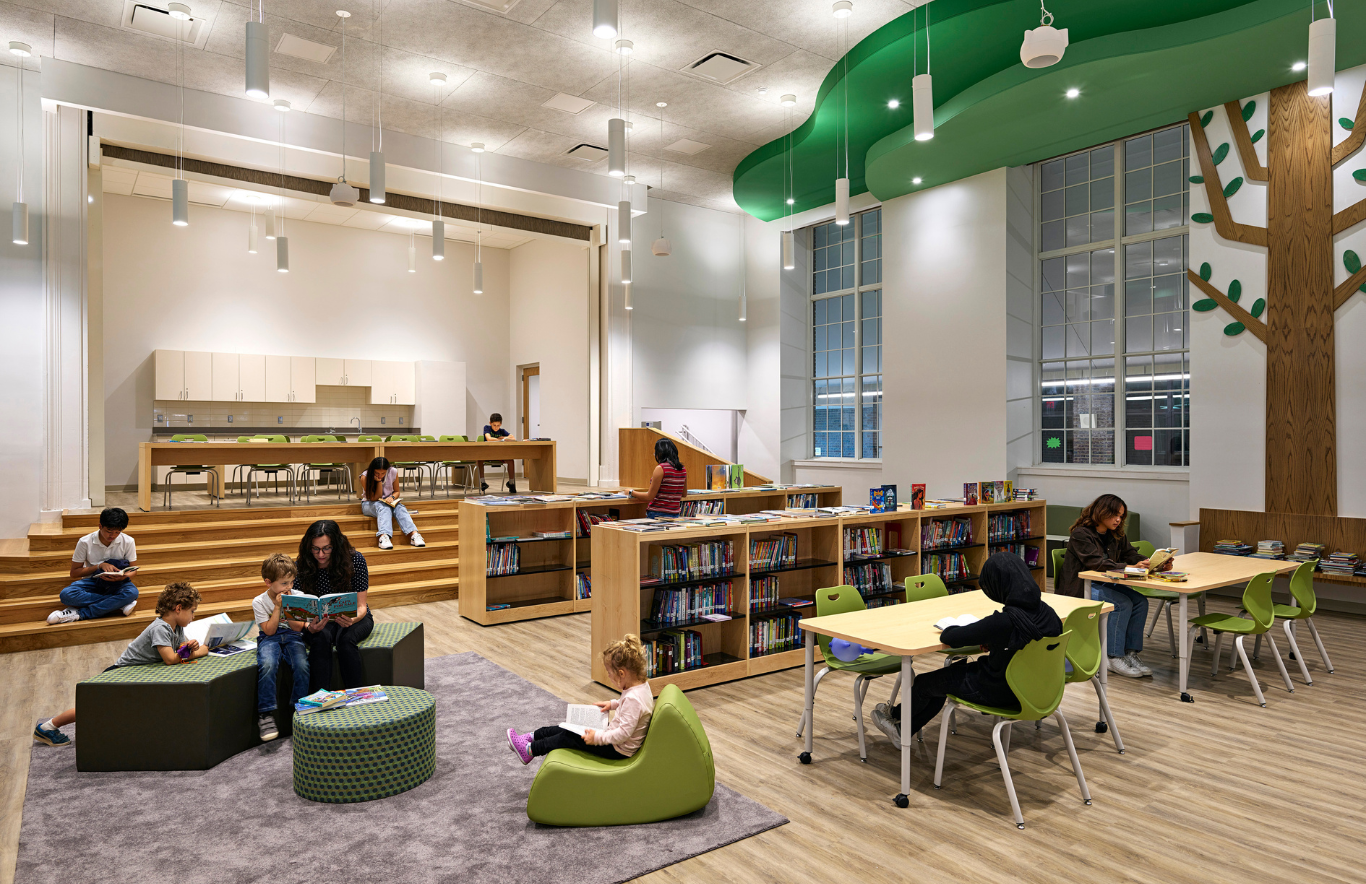
Many school buildings across the country, such as Capitol Hill Montessori in Washington, D.C., date back to the early 1900s. | Photo Credit: Tom Holdsworth Photography
By Sarah Eynon
The modern classroom is no longer defined by the typical four walls and a chalkboard. Today’s students learn across physical and digital environments simultaneously, and the spaces designed to support them must evolve accordingly. As schools continue to balance in-person and remote learning, equity has become the central design challenge ensuring every student, regardless of where or how they learn, has access to the same quality of accessibility, technology, and experience.
Energy Efficiency & Addressing Aging Infrastructure
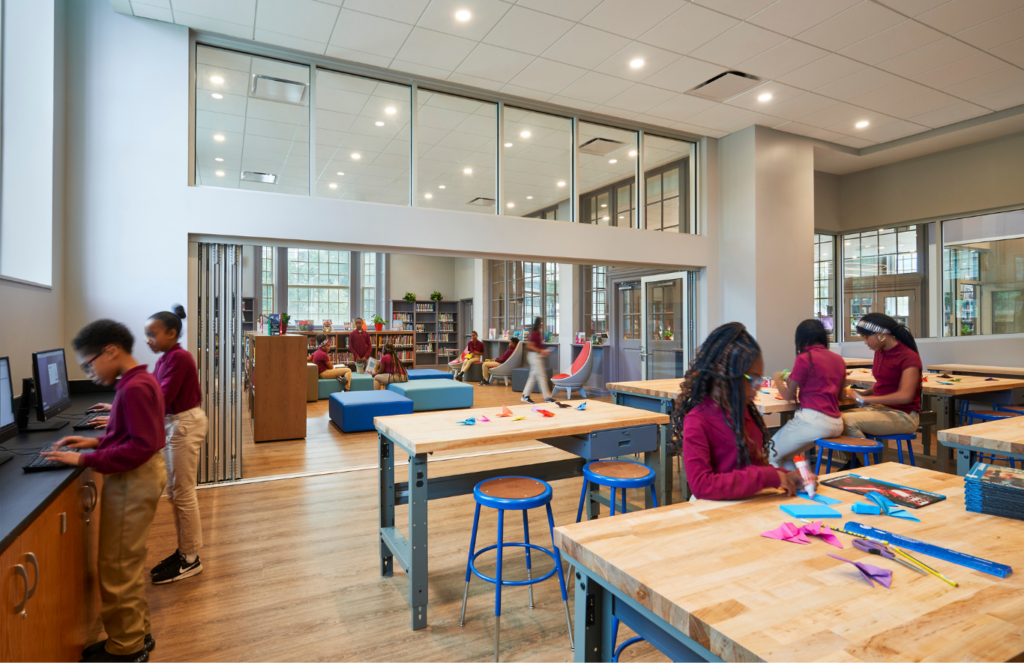
At the foundation of classroom equity is energy efficiency and infrastructure modernization. Many school buildings across the country, particularly in urban centers like Washington, D.C., date back to the early 1900s. These facilities were never designed to support today’s electrical demands, digital tools, or climate requirements. In some cases, classrooms still rely on open windows for ventilation or operate using a limited number of electrical outlets, constraints that directly affect learning outcomes.
Energy-efficient upgrades are essential not only for sustainability, but also for reliability and comfort. Net-zero energy buildings, (those that produce as much energy as they consume), are becoming a benchmark for new construction. Achieving this requires comprehensive HVAC upgrades, proper ductwork, and building systems that support consistent indoor air quality. In D.C., new buildings must meet strict energy efficiency standards, reinforcing the need for solutions that are both compliant and adaptable over time.
Technology Integration & Space Adaptability
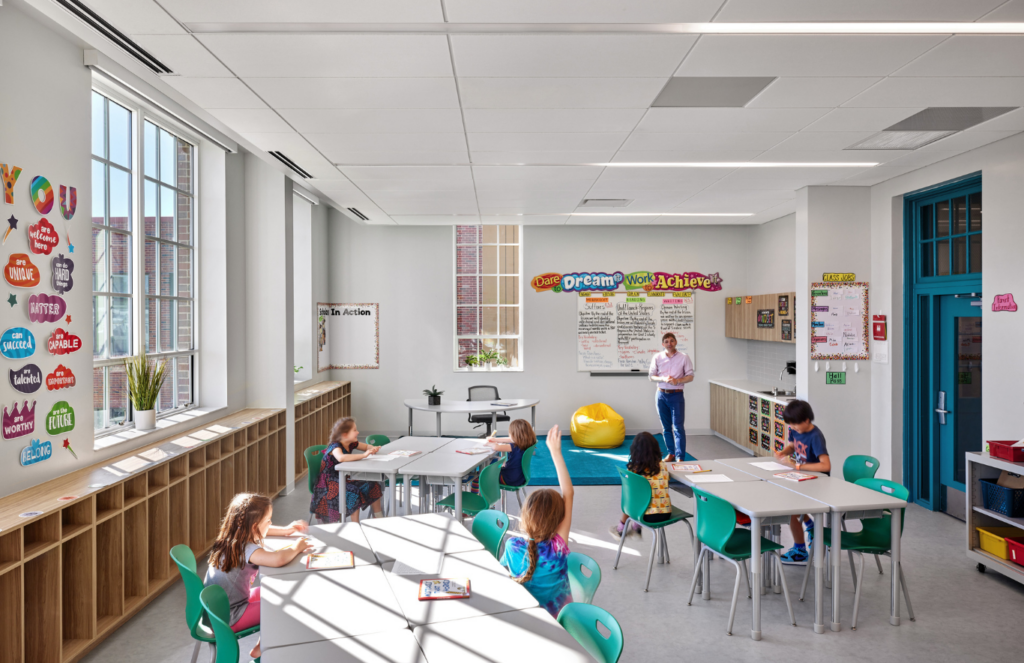
Addressing aging infrastructure often requires a range of strategic approaches. Some projects involve removing interior walls to create flexible, open learning environments, in an effort to preserve historic exteriors. Others require full replacements of outdated electrical and HVAC systems to meet modern educational demands. For buildings constructed in the 1960s through the 1980s, demolition and rebuilding may be the most practical option when renovation is no longer feasible when comparing cost benefits.
Technology integration is another critical component of equitable classroom design. Today’s classrooms are expected to support smart boards, projectors, speaker-tracking cameras, and robust Wi-Fi infrastructure as standard tools, not just as enhancements. These technologies enable hybrid learning models that allow remote students to participate meaningfully alongside those in the room and provide the accessibility needed.
Technology alone, however, is not enough. Staff training is essential to ensure tools are used effectively and consistently. Recorded training sessions, user manuals, and accessible resources allow educators to learn at their own pace and revisit materials as needed. Environmental controls also play a key role. Dimmable lighting and quiet HVAC systems reduce distractions and give students greater control over their surroundings. Sound equity is particularly important as students should never have to ask a teacher to speak louder due to poor acoustics. Similarly, having an adaptable sound or lighting environment is conducive for those that have visual or learning sensitivities.
Beyond technology, classrooms must be malleable for the range educational learning platforms. A single space may host lectures, arts programming, or STEM activities throughout the day. Portable furniture and modular layouts allow rooms to transform quickly, while dedicated maker spaces and outdoor learning environments support experiential learning and student engagement.
Funding & Policy Considerations
Funding and policy considerations add another layer of complexity, especially in Washington, D.C. Unlike municipalities that rely on bonds, D.C. school funding is partially provided by the federal government in two-year increments, requiring careful phasing and long-term planning. Projects must also pass through multiple regulatory bodies, including the Historic Preservation Board and the Commission of Fine Arts. Even demolition and new construction often require historic evaluations that affect schedules and budgets.
As a result, budget planning is a critical success factor. Inadaquate cost forecasting can derail even the most well-intentioned projects. It is advisable to have a full-time cost consultant to help schools align funding cycles with realistic construction timelines and long-term operational goals.
Equity, Community, and Stakeholder Engagement
Equity also extends beyond students to the broader community. Schools increasingly serve as community hubs, hosting afterschool programs, arts events, and civic gatherings. Designing spaces that are welcoming, flexible, and accessible ensures facilities support both educational and community needs. Inclusive classrooms prioritize accessibility and participation, allowing remote learners to engage fully rather than observe passively.
Stakeholder collaboration is essential in achieving these outcomes. Educational projects involve administrators, teachers, students, parents, engineers, designers, and preservationists, each with distinct priorities. Transparent communication and clear expectation-setting help manage feedback and build consensus, particularly when translating complex construction concepts for non-technical audiences.
Challenges & Looking Ahead
Looking ahead, schools are increasingly open to emerging technologies, including AI-driven tools, with minimal resistance. The focus is on balancing technological fluency with the development of critical thinking skills. Ultimately, classroom modernization is not about technology for its own sake, it is about creating environments that are engaging, inclusive, and future-ready, where every student has an equal opportunity to learn, participate, and succeed.
Sarah Eynon is Senior Director with MGAC.