

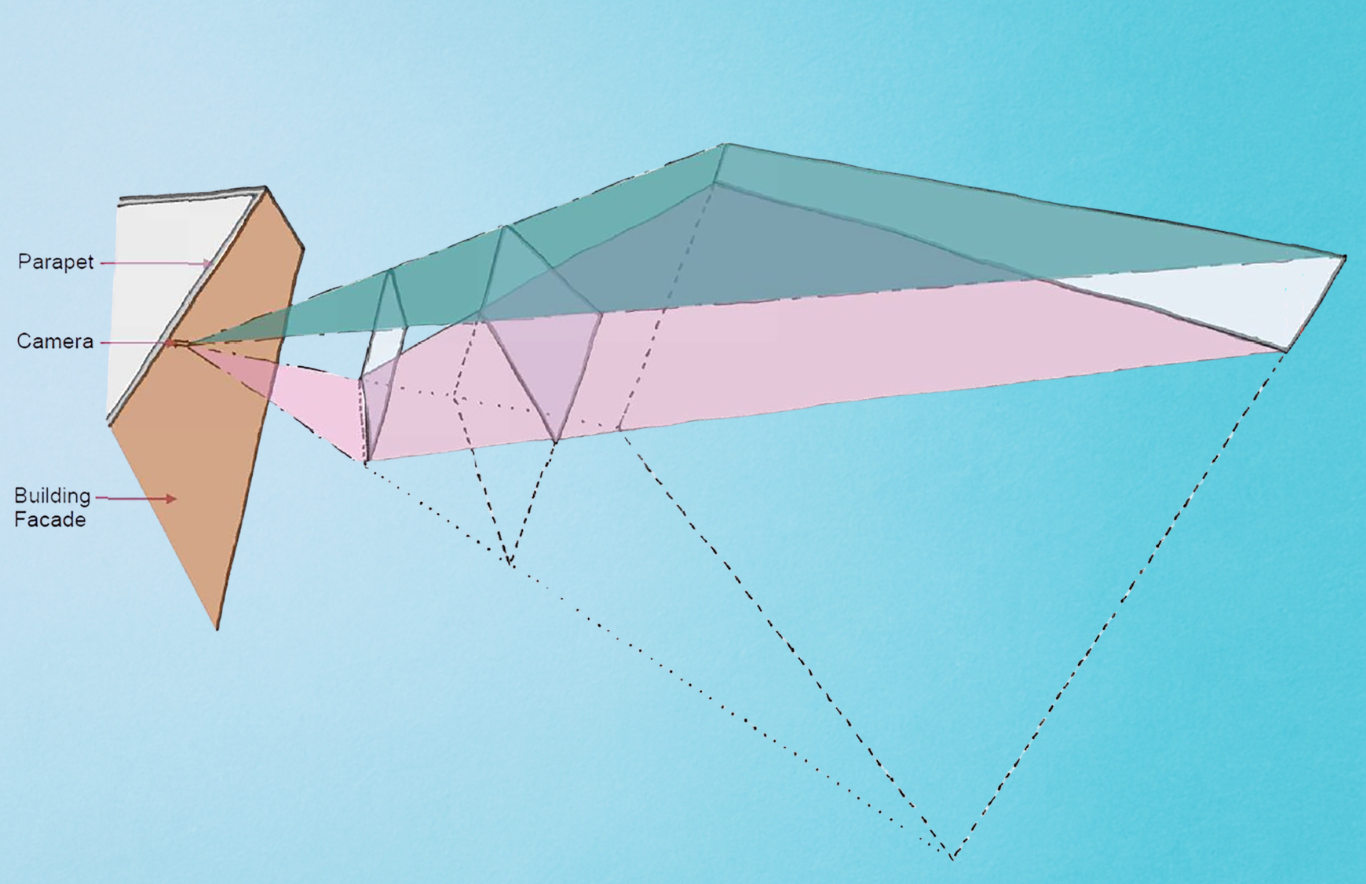
Diagrammatic representation of a camera mounted at parapet height to a building, indicating the various characteristics of the resulting view. | Photo Credit (all): Courtesy of Arcadis
By Jonathan Steel
From ChatGPT to Gemini and everything in between, it is easy to feel overwhelmed by the dizzying array of possibilities introduced by large language models (LLMs). Bombarded by clickbait that polarizes, oversimplifies, and misrepresents complex issues, forming an informed perspective can start to feel like more effort than it’s worth.
Arcadis helps clients navigate this landscape so they can benefit from these powerful tools in focused, practical ways tailored to their specific needs. This work is anchored within the firm’s computational design team. Capabilities in this area long predate the public launch of the first LLMs. Rather than starting from scratch, the team has expanded an existing toolkit for processing large volumes of data by integrating LLM capabilities that accelerate sorting, categorization, and pattern recognition.
Understanding Computational Design
So what is computational design, and why does it matter today? Put simply, it is a process for developing and evaluating high-performing options against a set of predetermined criteria using a combination of tools and technologies.
A simple way to think about it is baking a loaf of bread with no prior experience. Variables to experiment with might include oven temperature, bake time, the amount of yeast or how long the dough is kneaded. A computational design process models many combinations of these variables using available data to identify the settings most likely to produce a desired outcome. For example, a loaf with a soft interior and crusty exterior requires a different mix of variables than one intended to be evenly dense throughout. Computational design allows these trade-offs to be explored systematically, making it easier to understand how different inputs shape the final result.
Computational design truly comes into its own when datasets grow massive and the number of variables becomes so large that testing options through trial and error is far beyond what the human brain can manage within a reasonable timeframe. Unlike baking bread, these challenges cannot be solved through simple experimentation.
Consider the placement of stations along a proposed light rail line in a city. Decision-making must account for factors such as land availability, parcel costs, walking distances to nearby homes, access to services, and more. A computational design process can rapidly generate hundreds of thousands of possible scenarios and evaluate them against defined criteria in minutes, surfacing the options that best align with the chosen priorities and weightings.
Using Computational Design for Portland Public Schools
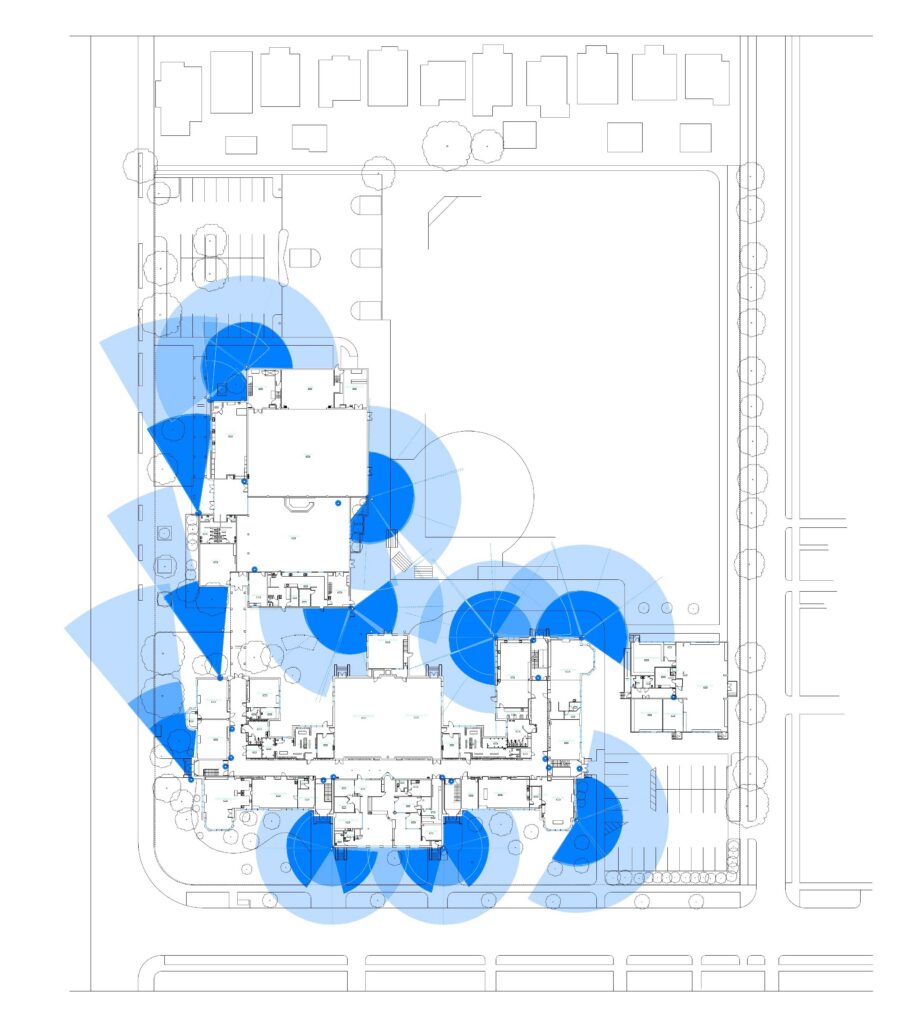
A clear example of how these capabilities have been applied to increase the value delivered to clients is the recently completed Portland Public Schools Security Camera Upgrades project. As part of the initial approach, a computational design process was used to optimize both the layout and selection of cameras across upgrades to 86 campuses districtwide. As demonstrated throughout this work, computational design excels at addressing complex, interrelated, multivariable challenges.
The challenge was clear from the outset: how to develop a process that could generate optimal camera placement designs across each campus while meeting two core objectives:
- Maximize coverage of the perimeter wall of any building.
- Maximize coverage of the parking lots on each site.
Three types of security cameras were considered for this application, each with its own focal range, field of view, and performance characteristics: wide-angle, varifocal, and multisensor. By modeling these camera types, applying them to accurately developed site drawings, and accounting for visual obstructions that affect coverage of building perimeters and parking areas, the team was able to use an evolutionary model to iteratively solve for optimal layouts. This approach delivered a solution that met the project schedule while coming in 40% under budget.
The $19 million project spanned 86 campuses and focused on achieving near-complete building perimeter camera coverage. Rather than applying a standard template, the team used parametric tools alongside practitioner insight to account for variations in building footprints, existing coverage, site conditions, and incident hotspots across the district. As districts continue to prioritize safety in capital planning, this work offers a grounded view of how large systems are approaching security upgrades in practice.
The Future of Computational Design in Academic Environments
Many everyday challenges are complex, interrelated, multivariable problems that are often solved in ways that are good enough rather than truly optimal. In most cases, this approach works. However, for businesses and public entities responsible for allocating significant resources to achieve specific outcomes, optimization becomes critically important.
Questions quickly emerge: What are the optimal routes and bus sizes to transport students across a school district? How can scheduling of classes at high school level best be distributed to balance minimizing travel distances between periods, maximizing credit availability, and minimizing teacher workload? How can food programs optimally meet student nutrition needs while minimizing food costs and preparation times, while maximizing appeal?
These are just a few examples of challenges where computational design can drive meaningful impact and support better outcomes. The question is simple: what complex, interrelated, multivariable problems are being tackled today that could benefit from the application of computational design? The opportunities are endless.
Jonathan Steel is a Principal and Business Unit Director, RIBA, ARB, for Arcadis.