
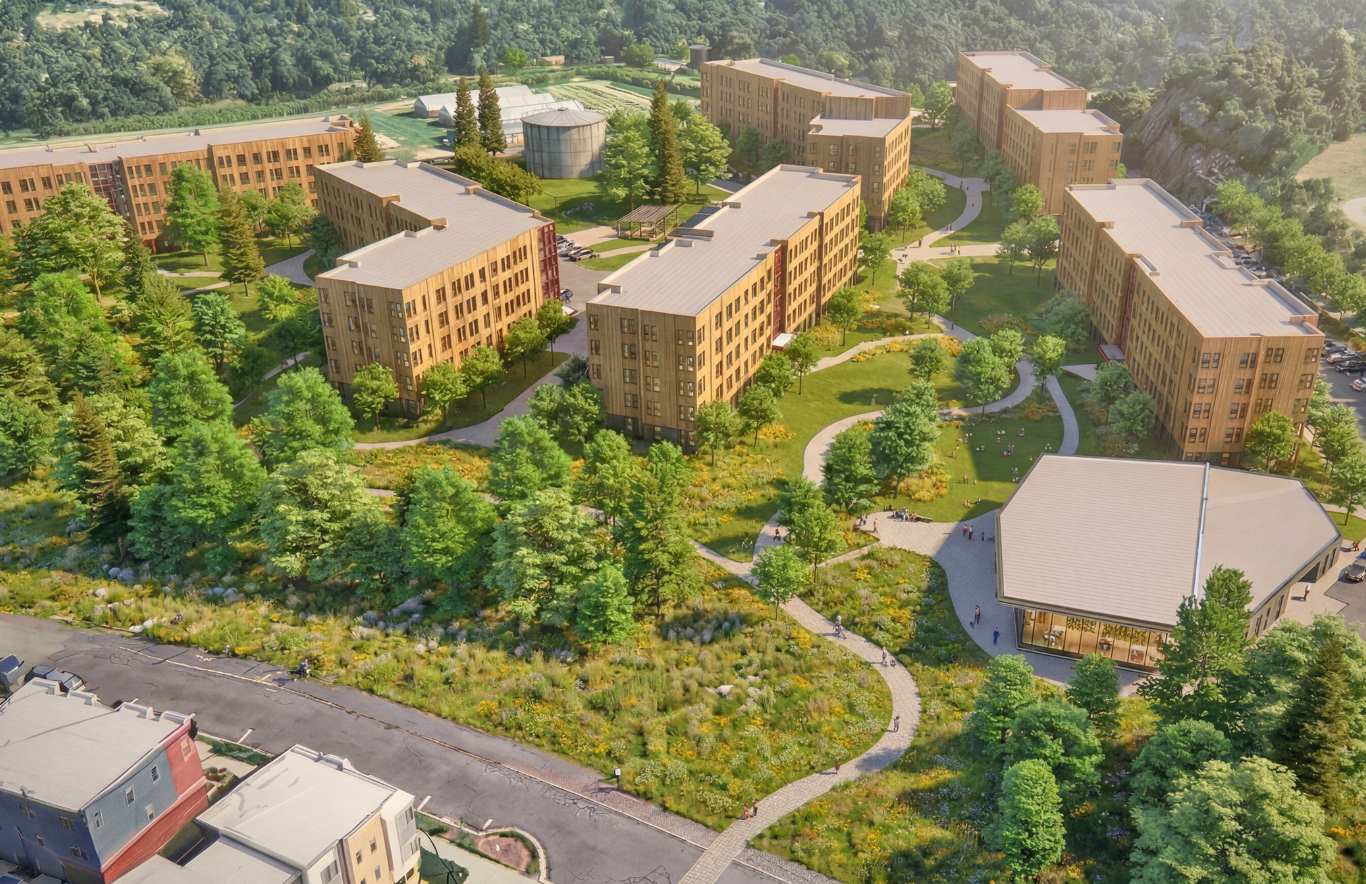
Cornell University’s Maplewood Graduate Housing Phase II is a new off-campus residential community designed to house 800 graduate students. | Photo Credit (all): Courtesy of CBT Architects
By Henry Weinberg, AIA, LEED AP BD+C, and Laura Rushfeldt, AIA, LEED AP
Humans have an innate desire to connect with nature, yet we spend nearly 90 percent of our lives indoors. In academic settings, where students learn, live and socialize, this disconnect can have real consequences for focus, mental health and well-being. Mass timber construction offers a powerful way to bring the warmth, texture and psychological benefits of nature indoors, while also advancing sustainability goals and, in many cases, matching or outperforming traditional steel construction on cost.
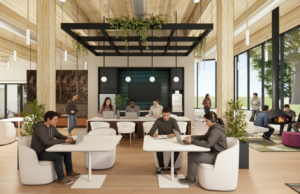
A growing body of research shows that biophilic design, the integration of natural elements, particularly wood, into the built environment can improve cognitive performance, creativity and mood while reducing stress and fatigue. Spaces that incorporate visible wood elements are consistently perceived as warmer and more welcoming, fostering social interaction and a stronger sense of belonging. For higher education institutions focused on student wellness and community-building, these qualities are increasingly viewed as essential.
CBT Architects is applying these principles at Cornell University’s Maplewood Graduate Housing Phase II, a new off-campus residential community designed to house 800 graduate students. At the center of the project is a freestanding Community Center, referred to as the Clubhouse, conceived as the social and programmatic “heart” of the development. Entirely constructed from mass timber, the pavilion-style building demonstrates how biophilia, sustainability and cost responsibility can align.
The 11,000-square-foot, single-story Clubhouse will consolidate wellness and community programs into a single central location, becoming a highly visible show point and social hub for leisure and connection. A floor-to-ceiling window wall wraps the public areas and reinforces the project’s strong indoor-outdoor connections by offering unobstructed views of the surrounding landscape and flooding the interior with daylight. Adjacent to the building, a generous spill-out terrace supports indoor-outdoor dining, events and daily relaxation—further strengthening the connection between architecture and nature.
The Biophilic Advantage of Mass Timber
Utilizing approximately 84 cubic meters of mass timber, including glue-laminated (glu-lam) columns and beams and cross-laminated timber (CLT) ceiling panels, the fully exposed structural elements allow occupants to experience the material directly, visually, spatially and emotionally.
This exposure is key to maximizing biophilic benefit. Unlike steel, which typically requires layers of fireproofing and finish materials, mass timber can remain visible, allowing its natural grain, color and texture to define the interior character. The result is a simpler, thinner assembly made up of fewer materials, reducing embodied carbon while enhancing aesthetic impact.
By centralizing both community programming and mass timber construction into the Clubhouse, the design consolidates benefits for all residents. Rather than spreading timber features thinly across multiple buildings, the project achieves maximum impact with a focused investment, creating a shared social hub where biophilic design is experienced daily.
Rethinking the Cost Conversation
One of the most persistent misconceptions about mass timber is cost. While early projects carried premiums tied to perceived risk and uncertainty around emerging building systems, as well as limited supply, market conditions have shifted rapidly. As more manufacturers come online and design teams gain experience, mass timber is increasingly achieving cost parity with, and in some cases outperforming, traditional steel construction.
At Maplewood, the design and construction team conducted side-by-side cost analyses of steel and mass timber structural systems at multiple design milestones. The results consistently showed comparable material and construction costs. Several factors influenced this outcome-.
First, the Clubhouse’s modest scale made it less efficient for steel fabrication shops, while mass timber providers, particularly those seeking to expand in the Northeast, were eager to deliver a highly visible, proven project. Competitive bidding at one pricing milestone showed mass timber coming in lower than steel.
Second, designing for mass timber from day one allowed the team to optimize the building around material efficiencies. As a single-story, Type V structure with a relatively small footprint, the building does not require a fire-rated ceiling assembly. This enabled the use of 3-ply CLT panels instead of thicker 5- or 7-ply assemblies, reducing material volume and cost.
Third, efficient structural spans further streamlined construction. Glu-lam elements are spaced at 15 feet on center, allowing simple one-way spanning without the need for deeper primary framing elements such as girders. This structural clarity simplified mechanical distribution, reduced coordination complexity, and supported faster installation—delivering schedule efficiencies alongside cost control.
Finally, pricing stability played a role. Steel costs are historically volatile, influenced by global demand, tariffs and energy prices. Mass timber pricing, by comparison, has tended to be steadier, offering owners greater predictability during design and procurement.
Henry Weinberg, AIA, LEED AP BD+C, is an Associate Principal at CBT Architects.
Laura Rushfeldt, AIA, LEED AP, is an Associate Principal at CBT Architects.