
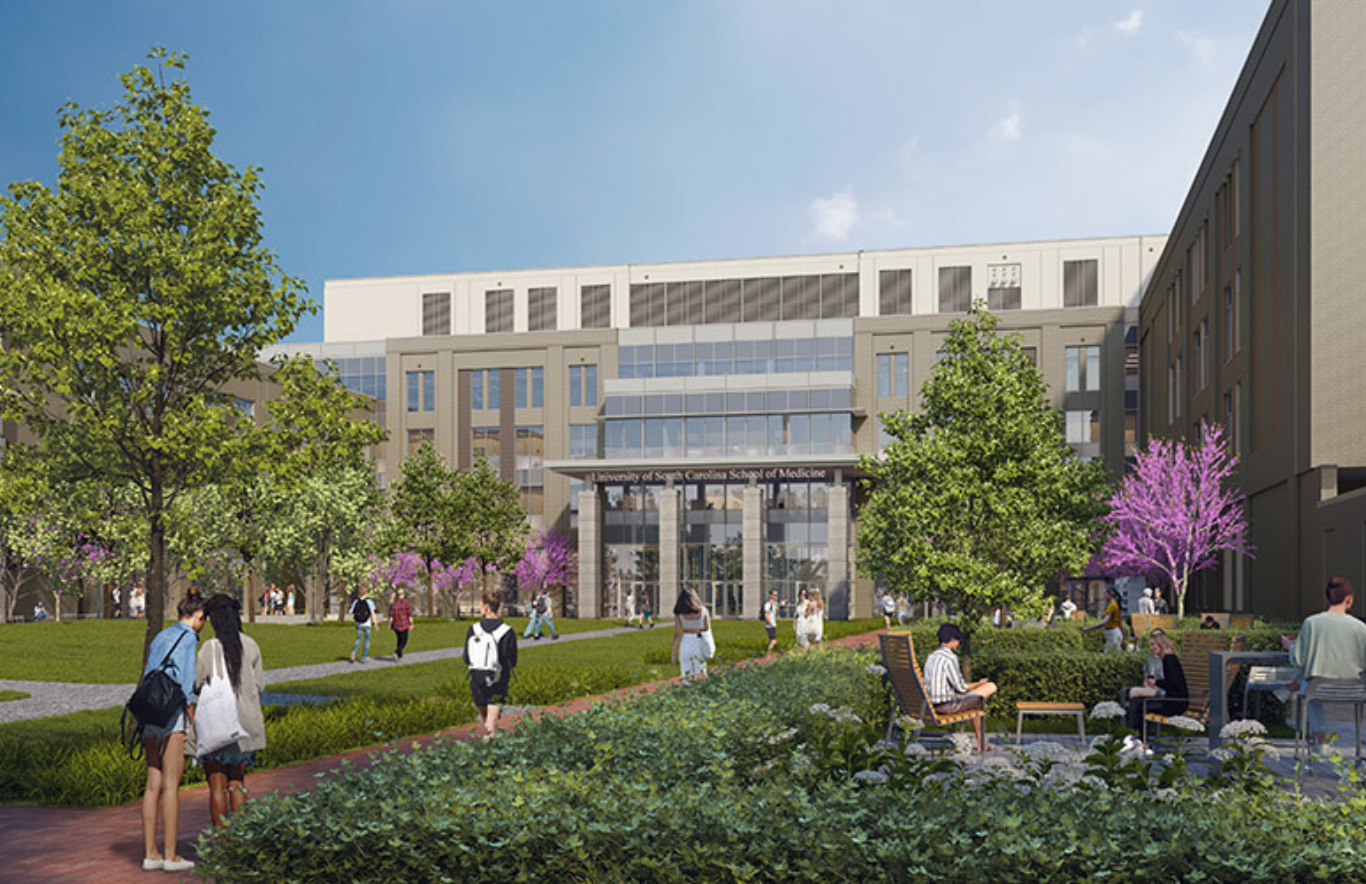
At the University of South Carolina, the P3 model is supporting a new home for the School of Medicine. | Photo Credit: The SLAM Collaborative, The Boudreaux Group
By Paul Choquette III
It is a difficult time to run an American college or university. Challenges lurk around every corner: there’s policy uncertainty in Washington, with potentially significant financial impacts, changes to U.S. demographics could cause changes to enrollment trends–not to mention the rising costs associated with a degree.
This broader environment makes it far more challenging for administrators to win what is rapidly becoming a fierce competition for student attention and enrollment as they apply to a wider range of schools than ever before. Schools with modern, updated and amenitized physical infrastructure — facilities and housing alike — are best equipped to win this competition and manage the current and forthcoming challenges facing the sector.
Given the tough financial climate, that might seem like bad news, but that misses a truly exciting trend in the industry: schools can engage in public-private partnerships (P3) with integrated, experienced firms to reduce costs, deliver projects at speed and scale, and bring an adaptable model to position themselves for success.
The Student Housing Supply Crisis
Let’s start by looking at student housing. There is an extreme mismatch between supply and demand on America’s campuses. The top 175 American universities had capacity to house only about 20 percent of students on campus in 2025. The situation is not much better off-campus, with the overwhelming majority of privately-owned, purpose-built student housing near campuses 95 percent occupied.
This drives prices up even as students expect innovative amenities on campus.
Gone are the days of the traditional dorm, with just about a fifth of students preferring that arrangement. Instead, students increasingly want single rooms or apartment-style living, coupled with social programming to foster a meaningful sense of connection. This no longer applies to just undergraduates or underclassmen: upper-division students also want to live on campus.
Demographic Shifts and Rising Competition
It’s also worth considering the upcoming demographic changes coming to the sector, with the number of American high school graduates expected to have peaked in 2025 and projected to decline for the next 16 years.
This tells us that there could be some demand relief to a housing submarket with no current vacancy. It also reinforces that institutions will now find themselves subjected to far more competition for student attention and dollars.
The P3 Model as a Strategic Solution
That’s where the P3 model comes in. This is the work done each day at Gilbane, which helped colleges and universities renovate or create 16,000 modern student beds last year alone, ranking us as a top 10 student housing developer and the number one education facilities builder in the nation.
The primary issue to solve is, as usual, financial. But there is also urgency. These projects must be delivered against academic schedules and conducted in a rapidly evolving landscape for students and administrators.
That’s why Gilbane created a design-build-finance-operate-maintain model: it allows the company to accelerate schedules, support long-term accountability and save schools money. Under this model, Gilbane manages the entire construction and development process from start to finish. It also handles the long-term operation of the facilities themselves — creating one point of accountability.
The model works.
Case Study: Palm Beach Atlantic University
Consider Palm Beach Atlantic University (PBAU), where Gilbane is helping deliver a $240 million development with a new, 25-story mixed-use residence hall. The partnership is creating 990 new student beds, and generating new dining, health, recreation and parking facilities.
The best part of this endeavor, however, is that it cost just $9 million of university equity while correcting outdated master leasing agreements that were preventing PBAU from retaining housing, dining and parking revenue. Gilbane broke ground several months ago and will be finished ahead of the 2027-28 academic year.
Expanding Beyond Housing
The Gilbane P3 model brings expanded solutions to existing educational clients and helps those higher institutions deliver more than housing. The power of this approach can help universities with projects that may require complex phasing, long-term operating plans and coordination with multiple stakeholders.
At the University of South Carolina (USC), for example, the P3 model is supporting a new home for the School of Medicine on its emerging Health Sciences Campus. Through this vertically-integrated approach, Gilbane brought predictability to USC and will deliver state-of-the-art classrooms, research labs, medical simulation spaces, a health-science library and event spaces, creating a new a permanent downtown health sciences campus for the University.
A Path Forward for Colleges and Universities
College — and the built environment that shapes it — is changing quickly, and so are student (and parent) expectations. But as each of these transformational developments demonstrates, solutions to these complex problems do exist. Better yet, those solutions can be executed without additional strain on already-strapped financials.
Paul Choquette III, a fifth-generation member of the Gilbane family, serves as Regional President for Gilbane Building and leads the firm’s national Public-Private Partnership (P3) strategy.
Read the full article in the Higher Education Issue of School Construction News.