
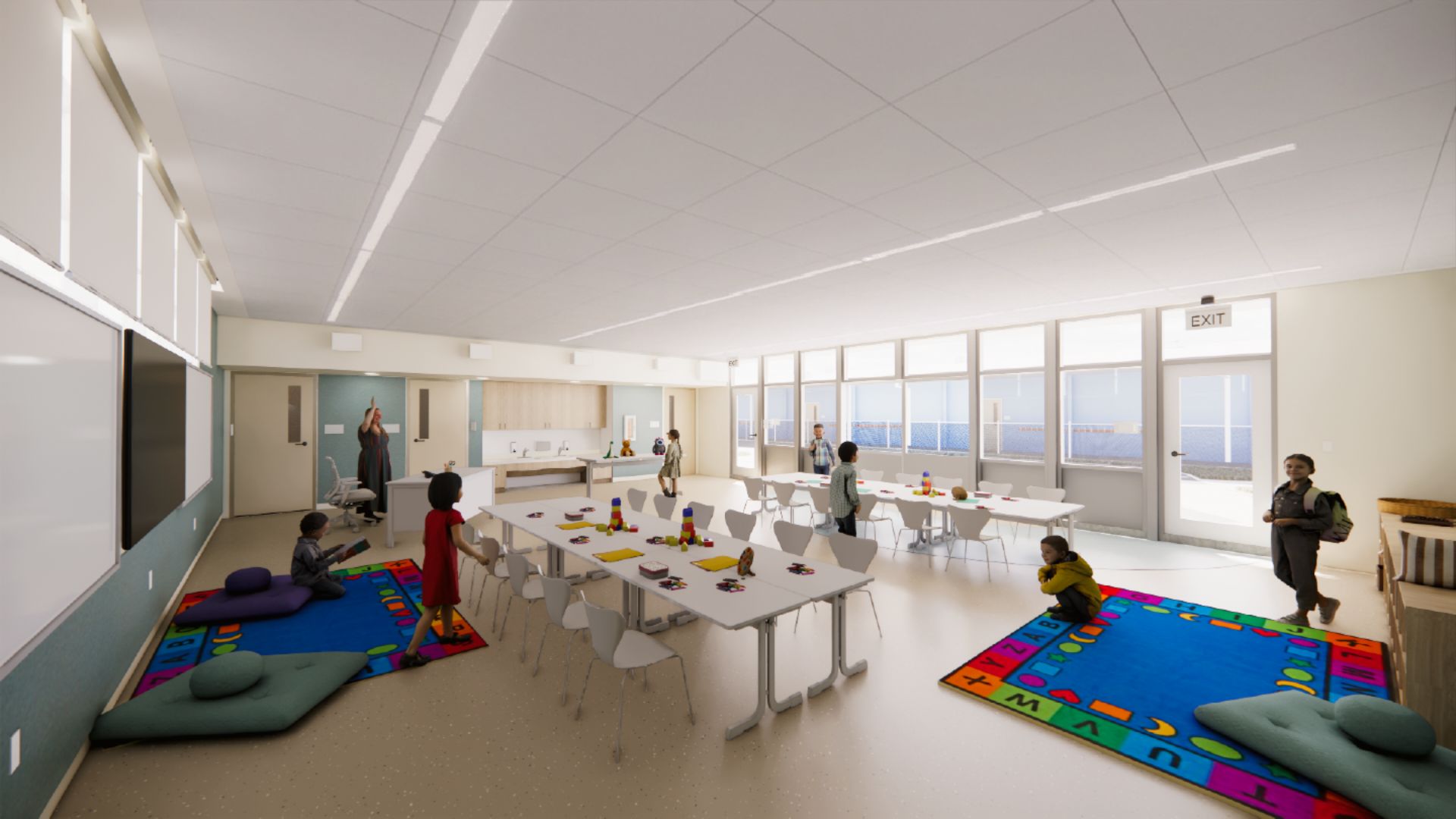
Pacific Elementary School TK-Classroom Modernization for Manhattan Beach Unified School District, designed by HCM. | Photo Credit (all): Courtesy of HCM
By Lindsey Coulter
HMC Architects recently welcomed Oliver Nicolas to the firm’s PreK-12 practice as Principal-in-Charge.
With a dual foundation in architecture and civil engineering, Nicolas brings more than 23 years of experience delivering impactful PreK–12, healthcare, and residential projects. He also spent six years at a structural engineering firm and as a specification sales representative for a wood manufacturing company, giving him a comprehensive perspective on efficiently managing and delivering school construction projects.
“My background gives me a unique perspective on design and delivery,” Nicolas said. “Understanding structural engineering and available materials influences how I view a space. Everything we design must be buildable, so as I design, I’m already thinking about how structural and architectural elements will be attached and how important detailing is in construction.”
Based in the firm’s Ontario, Calif., studio, Nicolas will work closely with district clients across Southern California, ensuring strong collaboration and a seamless client experience. Drawing on more than two decades of experience guiding projects from design through construction administration and certification, he will provide strategic oversight to align project goals with client priorities throughout the project lifecycle.
Nicolas spoke with School Construction News about regional trends, how districts are approach deferred maintenance projects and how early collaboration can help prevent problems later in the project lifecycle.
SCN: What makes working within an existing school building particularly challenging, and where do you see the greatest opportunities for creative design?
Nicolas: Renovations challenge designers because existing buildings impose strict parameters. We must deliver everything the client needs within a confined space. I once worked with a healthcare client to develop a tiny ADA code-compliant single-user restroom. Due to space limitations, we couldn’t expand and had to find every opportunity to meet code within the tight space. Schools face these same challenges, and I find that the spaces that seem the smallest are the most challenging to work within yet provide amazing opportunities for success.
SCN: Across Southern California, what are you hearing most frequently from school districts about their facility needs and priorities right now?
Nicolas: Our district clients are most concerned about declining enrollment and how to repurpose underutilized or aging spaces. Schools don’t want to sell extra property, finding new uses for these spaces will be one of the biggest challenges, and opportunities, for school architects in the near future. Districts are also exploring ways to serve diverse community needs with workforce housing, wellness spaces, and other shared use spaces. This approach raises important questions about after-school access, operations and maintenance — and how to open the campus to the wider community while maintaining student safety.
SCN: Many districts are balancing aging facilities and deferred maintenance with limited funding. How should districts think strategically about modernization versus new construction?
Nicolas: Before a district focuses on repurposing underutilized or aging spaces, it should start with a comprehensive, long-term facilities masterplan. The planning process should evaluate each school site in its full context, considering existing conditions, educational adequacy, adaptability, and total cost of ownership, rather than relying solely on a building’s age. Modernization is often a smart investment when a structure has good bones and can be transformed to meet the district’s needs. New construction should be considered when the existing site or building limitations prevent the district from achieving its goals.
SCN: What are some of the biggest misconceptions about what can — or cannot — be accomplished within an existing school building or site?
Nicolas: The biggest misconceptions about working within an existing space are that it is expensive or tearing it down is easier. However, I’ve seen that working within an existing space often costs less, promotes sustainability, and produces magnificent learner-focused spaces. Architects can make something out of anything. If the district has a vision, architects are savvy enough to come up with a solution. When we think creatively and look at a space in its full context, we can always come up with something that achieves the client’s vision.
SCN: With your experience on the construction and materials side, what are some of the decisions architects and districts can make earlier in the process that have the greatest impact on cost, constructability and schedule?
Nicolas: It’s important that architects and designers understand that cost escalation is a major issue, and we must deliver the project sooner rather than later to help clients save time and money. It’s important to find the right balance of the program, materials and construction type. For example, I know building with wood might present an up-front savings compared to steel. However, with an efficient design and construction strategy, steel can also help reduce timelines and the overall budget. When we involve every voice — districts, community and builders — early in our thought process, we can speed up the process and create a visionary project on time and within budget.
SCN: How can architects improve collaboration among districts, contractors, engineers and other project partners early enough to prevent problems later in the project lifecycle?
Nicolas: At HMC Architects, we engage clients and partners in a multi-day immersive design process. During the day, we host interactive workshops and brainstorming sessions with all interest holders. After hours, our design team works on a preliminary design based on these conversations. We reconvene with the full team to refine the design. This approach allows us to resolve issues that often take weeks or months to settle in a week or less. When we bring everyone together early, we see the best solutions to problems, identify previously unrecognized opportunities, and allow everyone to see the project develop in real time.