
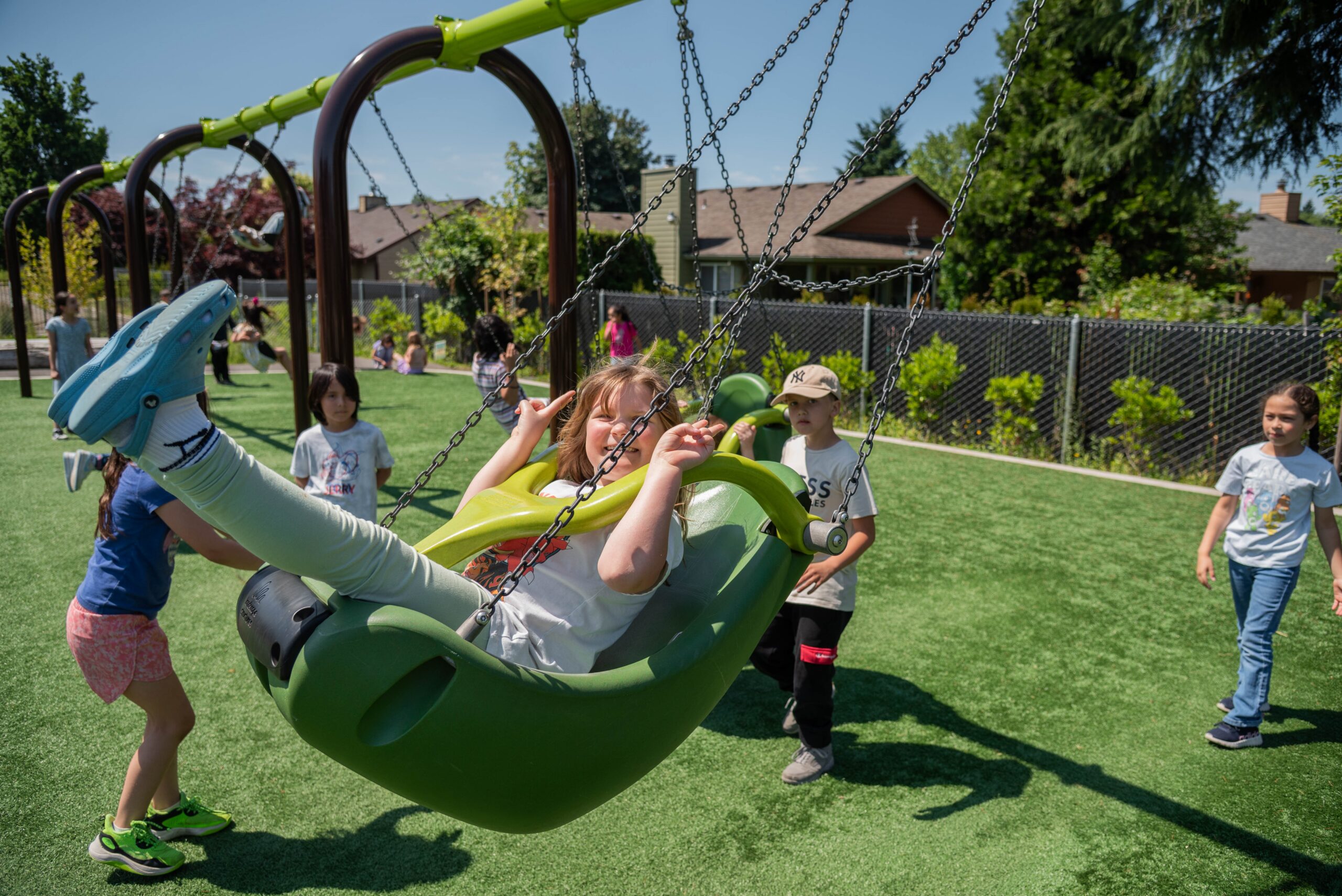
The future of education can extend beyond the confines of traditional classrooms. Inclusive playgrounds offer more than recreation; they are dynamic learning environments that support cognitive, social and emotional development. | Photo Credit: Westwood
By Chad Kennedy
Playgrounds have long been considered spaces for recreation, a place for children to expend energy between structured lessons. Yet, for all children, but in particular those with disabilities and sensory sensitivities, they represent something much more profound — an environment where social, cognitive and emotional development unfolds through play. Despite the potential benefits playgrounds have for childhood development, many decisionmakers still understandably perceive playgrounds as secondary to traditional classroom learning. This perspective, however, overlooks critical contributions that inclusive playgrounds can offer in childhood education and overall well-being.
Inclusive playgrounds are intentionally designed to include all children in play, providing diverse opportunities for exploration and learning in a safe, engaging environment. They help students develop social interaction skill sets, manage sensory input experiences and build emotional resilience — all essential to their educational success. As awareness of justice and sustainability in education grows, schools can aim to recognize and embrace these outdoor spaces as vital extensions of the learning environment.
To truly understand the significance of inclusive playgrounds, we must first examine the deep connection between play and learning — an essential relationship that extends far beyond the classroom walls.
The Educational Value of Playgrounds
Play is a fundamental part of childhood development. Through play, children learn to interact with the world, navigate social dynamics, and process sensory input. These skills cannot be mastered at a desk alone. Play spaces are critical for learning self-regulation and developing social skills in a low-pressure environment. Children with disabilities benefit greatly as they learn and practice these skills alongside their peers.
In an inclusive playground, students learn problem-solving, teamwork and conflict resolution in real-time. Sensory-friendly elements allow children to explore different inputs, helping them understand and manage their own personal sensory thresholds. Teachers can leverage playground time to extend their curriculum, using outdoor environments to teach concepts such as spatial awareness, cooperation and even science and physics through nature-based play elements like water tables, loose play parts and gardens.
Additionally, outdoor spaces provide sensory input that reinforces classroom lessons. Whether it’s a playground near a library that integrates story time into play or an outdoor stage for interactive learning, these spaces create experiential learning opportunities beyond scholastic exercises. Well-designed playgrounds immerse students in play-based, non-prescribed learning by recognizing that children have differing learning styles and diverse engagement methods.
While the benefits of play-based learning are clear, not all playgrounds are created equal. Traditional playgrounds often fall short of providing meaningful engagement for all children, which raises an important question: What makes a playground genuinely inclusive?
The Difference Between Conventional and Inclusive Playgrounds
Most traditional playgrounds focus on gross motor skills (running, climbing and jumping), often offering limited options for those with sensory sensitivities or mobility challenges. Conventional spaces regularly lack the flexibility to engage children with varying needs, creating unintentional barriers to play. The one-size-fits-all approach — installing standard slides, swings and jungle gyms — excludes large numbers of children with differing abilities.
On the other hand, inclusive playgrounds prioritize diversity in play by incorporating features that support all children regardless of ability. Thoughtful design choices, such as cozy retreat spaces, allow children to self-regulate when overwhelmed. These spaces provide a vantage point where children can observe the playground and engage, on their terms. Without them, children who experience sensory overload often withdraw to unsafe locations, such as under jungle gyms, behind structures or even outside the play space where they might be injured or get lost.
Loose-parts play — incorporating blocks, sticks, balls, natural plant parts and other movable components — supports creativity and sensory exploration, avoiding static features and encouraging dynamic play environments. Water and sand play areas allow children to manipulate materials and learn cause-and-effect relationships while engaging their senses. Meanwhile, incorporating nature-based/green landscape features instead of blacktop reduces heat and enhances the connection to nature, making the playground more inviting.
Schools also have advantages over public parks when implementing inclusive play spaces. Unlike public parks, schools are managed environments with constant oversight, allowing for the integration of docents/teachers/assistants who can monitor play. PTAs and school organizations serve as built-in support systems that can advocate for funding and facilitate long-term playground maintenance. Oversight also opens up the use of a wider range of loose play items that can be used more frequently and maintained in functioning order. With larger play spaces than many public parks, schools have room to design playgrounds that offer multiple experiences, from physical challenges to sensory engagement, to passive play.
Despite clear advantages of inclusive playgrounds, their adoption into school systems remains uneven. Several challenges — from funding limitations and maintenance preferences to outdated perceptions of play — hinder their widespread implementation. Part II of this article will explore some of those challenges, and outline effective strategies for successful adoption of inclusive playgrounds.
Chad Kennedy, FASLA, CPSI, is a Director, Landscape Architecture with Westwood.