
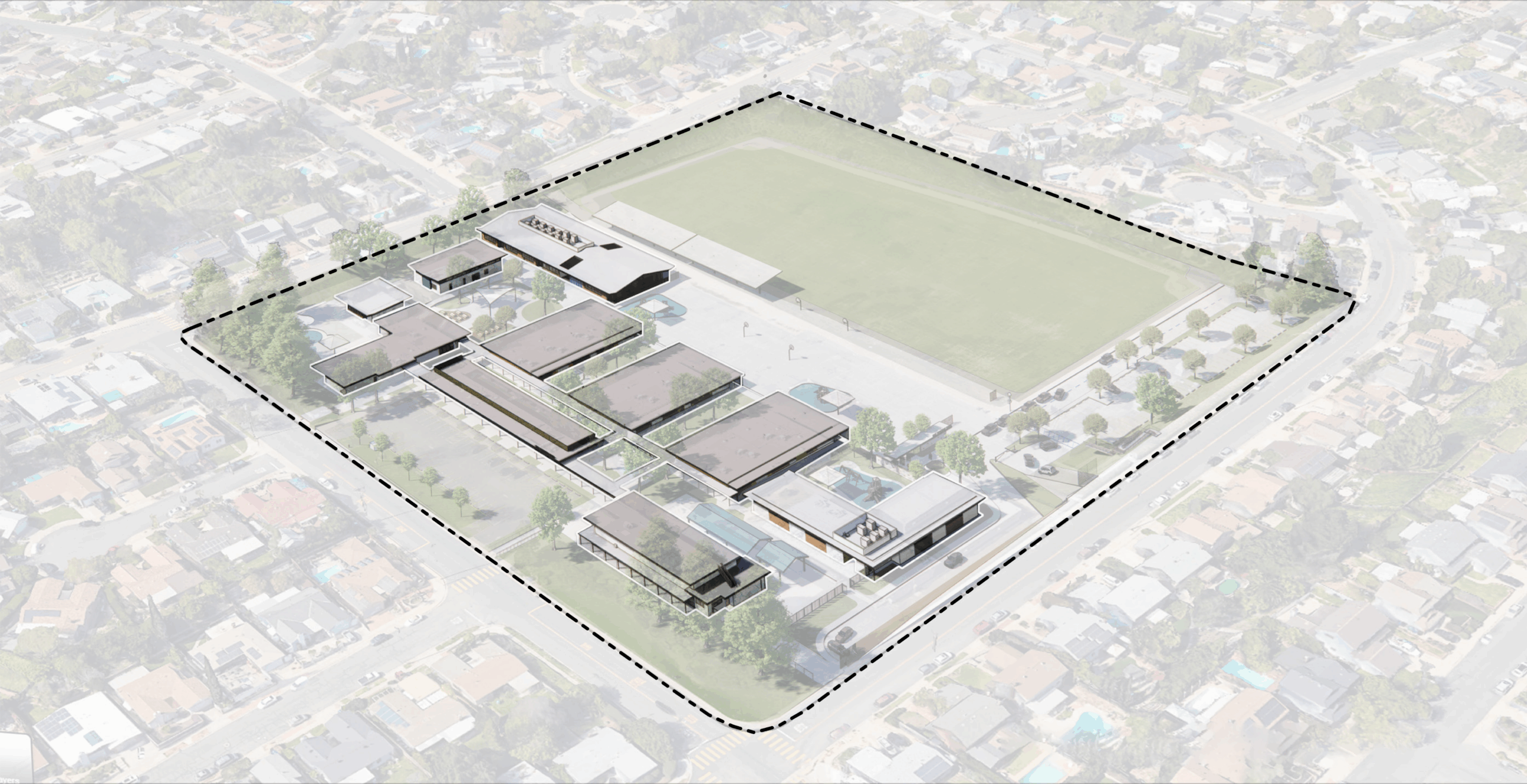
Photo: OCMI provided full cost estimates of modernization and replacement options for Gage Elementary School for the San Diego Unified School District. | Rendering courtesy of HMC Architects
By Michelle Kelly
In the ever-evolving landscape of K–12 education, school districts across the country are grappling with a pivotal question: When is it more prudent to renovate an aging facility, and when is it time to start fresh with a new build? The answer is far more nuanced than a simple cost comparison.
K-12 schools nationwide grapple with aging infrastructure, learning environments that fail to support today’s educational models, rising maintenance and operation costs and limited capital budgets. The decision to renovate or replace a K-12 school facility is one of the most consequential choices a district can make, impacting not only finances but also educational outcomes and community trust.
With rising materials and labor costs, it’s increasingly important for school districts to evaluate the cost of planned renovations against the cost of new construction today and in the future. While many projects are identified as part of multi-year bond programs and prioritized accordingly, budgeted funds are increasingly insufficient to complete the desired facility and program updates when the project is scheduled to begin.
Before proceeding with design, engaging an independent third-party cost estimator to assess both renovation and new construction options can provide critical context for making data-informed decisions.
Beyond the Bottom Line
“People often treat estimating as a checkbox during design,” said Conor Clarke, a cost estimator with OCMI Inc. “But it should be treated as a strategic step during programming or conceptual design — if not earlier — to help districts understand the constraints of renovation and replacement options.”
Michael Mejia, an expert in educational facility cost analysis at OCMI, agrees. “It’s not just about cost—it’s about fiscal responsibility and long-term planning. Especially in California, where DSA [Division of the State Architect] regulations can dramatically shift the scope of a project.”
The 50% Threshold: A Critical Pivot Point

When renovation costs near 50% of the cost of new construction, comparative estimates become essential — not only to determine whether to proceed, scale back, or opt for full replacement, but also to uncover hidden project factors that could significantly affect the final cost. Conducting these estimates early helps reduce risk and supports long-term, strategic planning for school districts.
In California, DSA mandates that if renovation costs exceed 50% of the replacement cost value (RCV), the project must include seismic upgrades — often triggering a cascade of additional code compliance requirements and costs. This threshold is calculated using DSA’s IR EB4 form, which sets a baseline replacement cost (currently $517 per square foot for K–12 schools). This is often significantly lower than actual market rates, which have been unable to keep pace with market movement over the last 10 years.
“Most of our renovation projects already exceed that $517 per square foot figure,” Mejia notes. In San Diego, for example, school construction costs range from $800 to $1,200 per square foot. Even modest renovations can inadvertently trigger seismic upgrades.
In Nevada, where no statewide threshold exists, the Clark County School District sees the highest renovation costs in HVAC and roofing, with only minimal to moderate interior updates. When costs near the replacement threshold, the question becomes: Is it worth spending millions to put a band-aid on a school that still falls short of meeting modern educational needs?
“Sustainability targets, although necessary from a climate standpoint, further increase the likelihood of these types of triggering events due to their higher associated costs,” said Clarke.
Areas with significant carbon reduction initiatives, like Washington and California, have a higher predisposition to seeing project costs in excess of replacement thresholds driven by the associated codes and standards that must be factored into a design, as opposed to the nature of the initial project.
Read the full article — including tips on calculating hidden costs, balancing needs with budgets and the case for new construction — in the July/August issue of School Construction News.
Michelle Kelly is a director of Business Development at OCMI Inc. in Seattle. OCMI is an independent cost estimating firm that takes a data-driven approach.