
The new Myrtle Grove Elementary School in Pensacola, Florida went through an in-depth process in its design and construction. | Photo Credit (all): Jason Buch
By Elizabeth Link
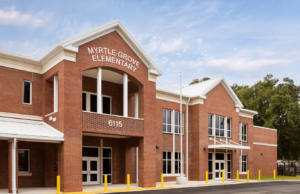
The new 77,000-square-foot, two-story Myrtle Grove Elementary School in Pensacola, Fla., serves PreK through fifth-grade students with 29 contemporary classrooms, a STEM lab, and outdoor learning spaces. The design celebrates the school’s history, while providing state-of-the-art educational technologies. Rather than erasing the past, the architectural approach transformed historical elements from the original 1939 building into meaningful design features, which required an in-depth process design and construction.
Honoring 150 years of educational legacy in Escambia County, the new school needed to solve three distinct challenges: honor the school’s legacy in the community, bring state-of-the-art learning environments to the county, and be seamlessly built on the same site as the existing school on an active campus.
What started as a single-phase project evolved into multiple phases during the programming stage, as studies and evolving stakeholder needs determined that more of the campus and facilities required replacement than originally anticipated. The only structure from the original school that the project team retained was the library/media center, which had been built in the 1990s and was still in good condition.
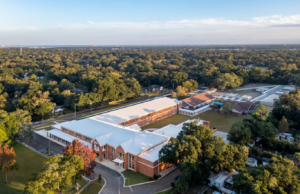
For Escambia County Public Schools, keeping the campus intact during construction was paramount. With two campus buildings no longer fully functional, the DAG Architects team began by creating a new master plan for the site that included acquiring 20 relocatable classroom buildings to be utilized during construction. The DAG team also renovated a separate existing building onsite to temporarily house the school’s administration department. As certain facilities, including a music and art building and an eight-classroom building, had to remain functional, a single-phase approach wasn’t possible. Instead, the design team opted for a phased approach to the project which offered many benefits, including:
- Minimal Operational Disruption — Phased construction allowed the school to remain open and operational (with minimal interruptions) by strategically sequencing tasks so specific areas remain accessible and functional throughout the project construction.
- Lower Risk Management — Each new construction phase built on the previous phase, making the overall construction process more manageable, as it was easier to source materials and labor. This reduced the likelihood of costly delays or complications.
- Flexibility to Adapt — Completing initial phases allowed stakeholders to provide feedback that informed subsequent stages, such as increasing the scope of the project. It also helped to mitigate possible challenges in the design, though this required increased diligence to the project and site.
Overcoming Project Challenges
The biggest challenge involved unknown conditions such as locating existing utilities and establishing water, sewer, fire and telecommunications connections to the temporary campus. Additionally, all power had to be rerouted in a manner that allowed the team to demolish buildings while still maintaining campus functionality. To further complicate the project, for a period in the construction process, all existing, temporary, and new systems had to function together, requiring careful coordination of fire alarm and telecommunications switches.
Additionally, because buildings were being demolished at different times, the project team had to carefully stage access while students were on campus. Intense scrutiny of the site was required, and the project team strictly adhered to safety requirements, such as installing double fences and closing off the temporary campus to maintain student safety.
When Phase I was completed, students and administrators moved into the newly constructed building. Currently, all temporary classrooms, buildings, and walkways are being removed, making way for future additions on the campus.
Developing the Design Philosophy
As a true neighborhood school, the project needed to preserve Myrtle Grove Elementary’s significance in the community. Rather than replicating the previous building’s appearance; the design team chose to provide something special to reinforce the school’s long history and its connection to the community.
DAG researched historic schools throughout Pensacola for inspiration, seeking to restore traditional elements that have been lost over time. The design ultimately incorporated traditional gables, red brick, brick patterning and white trim. All exterior surfaces feature real brick to give the building a timeless quality, while the interior uses elements such as terrazzo flooring, patterned tile and clay masonry that allude to its history.
Some elements of the school were even salvaged for use in the new facility. The decision as to which historic elements would be preserved was driven by stakeholders, including the school’s previous principal, who (during past interior upgrades) had saved the old wooden doors from the cafeteria. These became the doors to the balcony in the new building. Additionally, the wooden stage planks became a conference table and the historic cafeteria doors frame views from an upper balcony that overlooks the modern cafetorium.
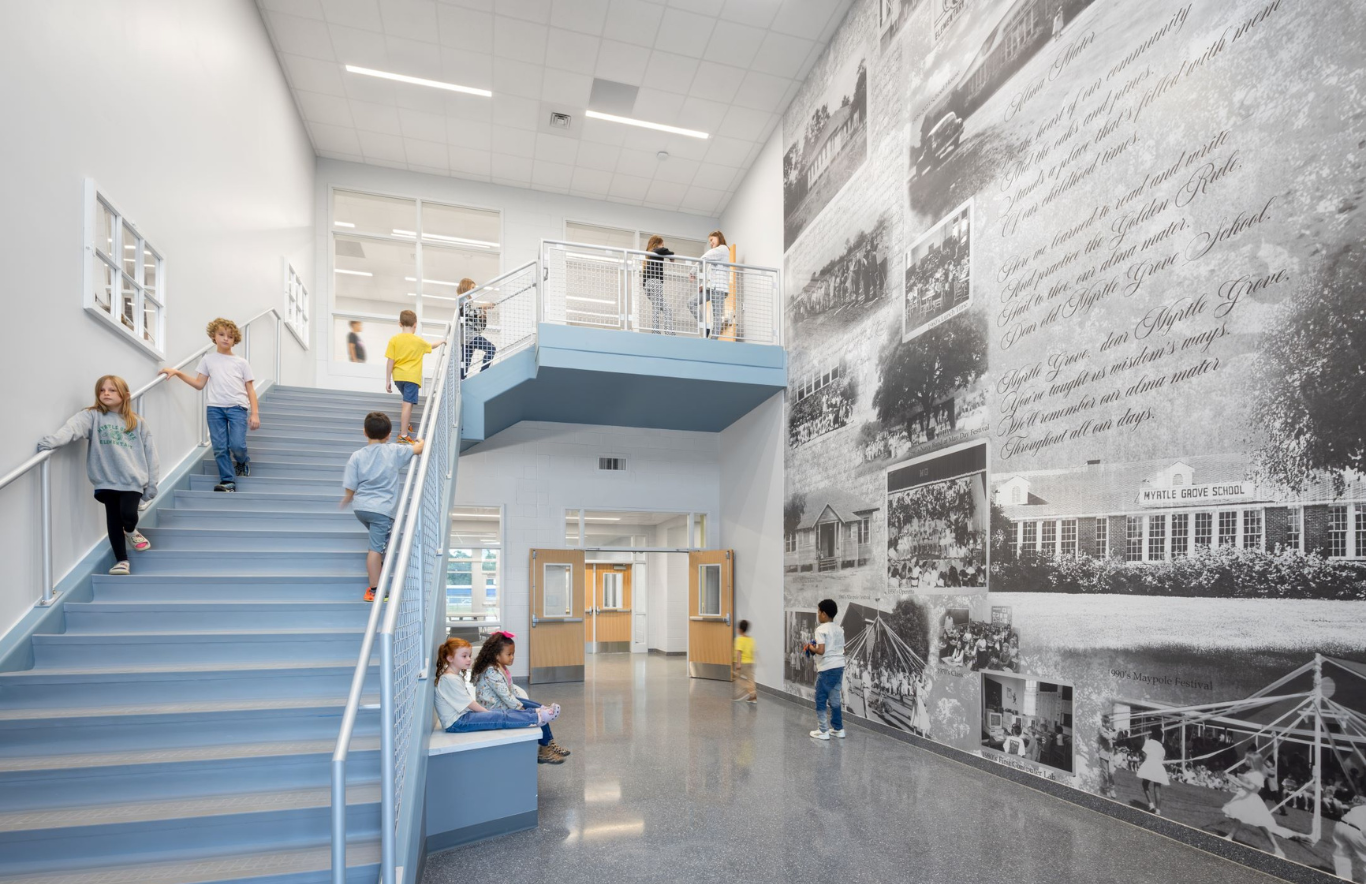
Similarly, DAG salvaged bricks and the old school letters from the demolished buildings and incorporated them as a feature of the main stairway in the new facility, mimicking an “entryway” to the exterior. Adjacent to this reconstructed wall is a two-story photographic mural containing photos spanning decades. The combination of elements creates an almost museum-like atmosphere. While this project is not a reconstruction, the building attempts to convey the same feeling as passing through the old school building. This solidifies space as a true member of the community, a place where generations of students will learn, grow, and maintain the legacy of Myrtle Grove Elementary School.
Phase II is set to be completed in 2027, which will add 16,000 square feet of multipurpose spaces for arts and physical education.
Elizabeth Link is Communication Manager for DAG Architects.